
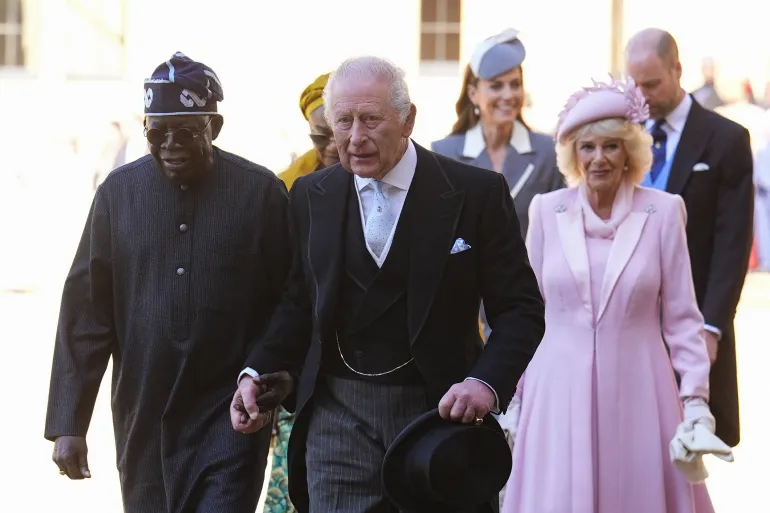
Bola Ahmed Tinubu received a historic royal welcome from King Charles III at Windsor Castle during a landmark state visit to the United Kingdom. The visit marks the first time in nearly four decades that a Nigerian leader has undertaken a formal state visit of this scale to Britain. Moreover, the occasion reflects renewed diplomatic engagement between Nigeria and the United Kingdom.
A Historic Moment in Nigeria–UK Relations
The historic visit placed Nigeria firmly at the centre of diplomatic discussions between Africa and Europe. Importantly, the visit also highlighted Nigeria’s growing influence in global affairs.
At Windsor Castle, King Charles III formally received President Bola Tinubu during a ceremonial welcome in the castle’s famous Quadrangle. The ceremony reflected centuries of British tradition and royal protocol. However, it also symbolised a renewed commitment to modern diplomatic partnership.
Furthermore, the visit underscored the long-standing relationship between Nigeria and the United Kingdom. Both countries share deep historical ties in governance, law, and education. Consequently, the meeting provided an opportunity to strengthen cooperation across several sectors.
The ceremonial reception also included the presence of Queen Camilla. The royal family’s participation added prestige to the diplomatic engagement. At the same time, it demonstrated Britain’s recognition of Nigeria’s importance on the global stage.
Strengthening Diplomatic and Economic Cooperation
President Tinubu’s visit focuses on strengthening cooperation between the two nations. In particular, discussions revolve around security collaboration, economic partnerships, and trade expansion.
Nigeria continues to play a strategic role in West Africa’s stability. Therefore, deeper cooperation with the United Kingdom remains vital for addressing regional security challenges. Both countries aim to improve intelligence sharing, counterterrorism efforts, and defence collaboration.
Additionally, the visit emphasises economic engagement. Nigeria seeks stronger investment partnerships with Britain in infrastructure, technology, and energy. Such collaboration could help accelerate Nigeria’s economic transformation.
The United Kingdom also views Nigeria as a key partner in Africa’s largest economy. Consequently, British policymakers see growing opportunities for trade and private-sector investment.
Celebrating Shared History and Cultural Connections
Beyond politics and economics, the visit highlights the cultural ties linking both nations. Nigeria and Britain share decades of historical connections that continue to shape their institutions and societies.
Nigeria’s legal system, for instance, reflects strong influences from British common law traditions. Similarly, parliamentary structures and civil service frameworks evolved from historical ties with Britain.
Furthermore, the Nigerian diaspora in the United Kingdom plays a major role in strengthening these connections. Nigerians contribute significantly to British society, particularly in healthcare, business, education, and sports.
Their contributions to institutions such as the National Health Service illustrate the close human connections between both countries.
Renewed Hope for Strategic Partnership
President Tinubu’s historic reception at Windsor Castle symbolises more than ceremonial diplomacy. Instead, it reflects a renewed chapter in Nigeria–UK relations.
The visit reinforces Nigeria’s commitment to global partnerships while advancing national interests. At the same time, it signals Britain’s willingness to deepen engagement with Africa’s most populous nation.
Looking ahead, both countries hope the renewed diplomatic momentum will translate into tangible benefits. Stronger cooperation could improve security, expand trade, and deepen cultural exchange.
Ultimately, the historic meeting between President Bola Tinubu and King Charles III represents a powerful moment of diplomacy. It signals mutual respect, shared history, and a common vision for future cooperation between Nigeria and the United Kingdom.