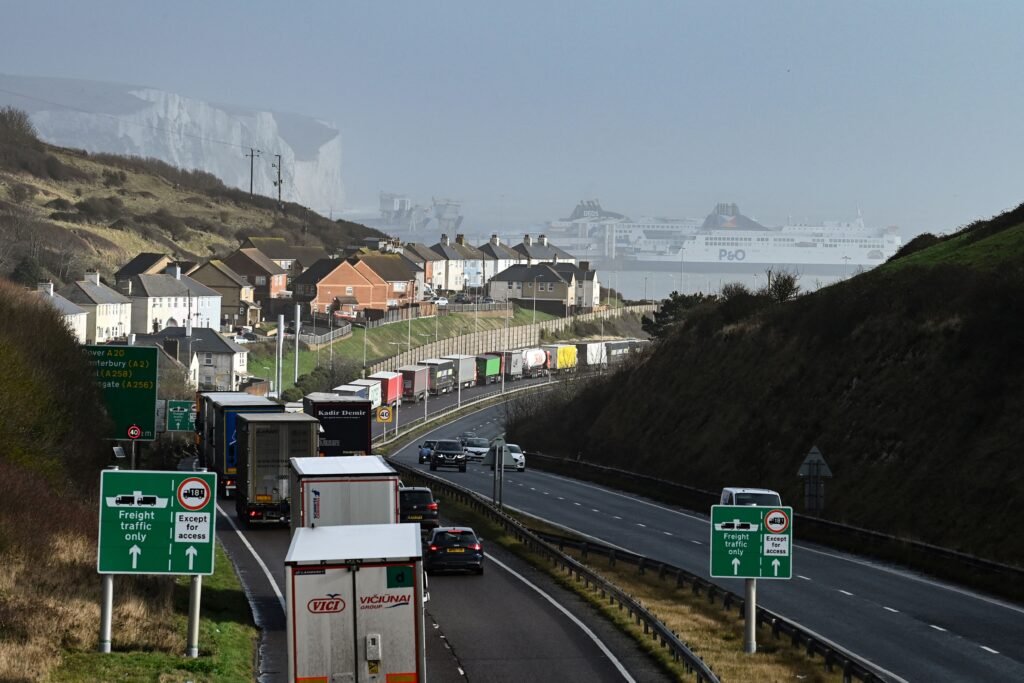
LONDON — British truck drivers say they are at risk of losing their jobs because of impending EU border controls, as haulage firms scramble to adapt to the rules ahead of deadline.
From April 10, the EU will begin fully enforcing its long-delayed Entry/Exit system. That will mean digital border checks for non-EU travelers, including Brits traveling post-Brexit — who are limited to spending no more than 90 days in any 180-day period in the EU before they have to leave.
While the 90-day rule has technically been in place since Jan. 1, 2021 — when Brexit ended free movement of people between the EU and the U.K. — it has been loosely enforced, relying mainly on passport stamps, making it difficult for authorities to track how long travelers have stayed in the bloc.
The EU claims the system is necessary to strengthen border security. But for many British truck drivers who rely on frictionless travel in Europe to do their jobs, it could spell disaster.
The new checks take effect just as Britain seeks to strengthen ties with the bloc it voted to leave nearly ten years ago, with the Labour government negotiating closer alignment in a number of sectors.
‘It will cause carnage’
“I’ve got no doubt that it will cause carnage,” said Toby Ovens, managing director at the Wiltshire-based Broughton Transport, an international transport firm exporting food to the EU.
“It’s going to make our job 10 times harder, and the reality is we’re going to have to potentially focus on employing European drivers working for a British company over employing British drivers to get ourselves out of that hole, which goes completely against the grain. That’s just the harsh reality.”
The firm currently operates a fleet of 80 vehicles, with around 60 drivers traveling to Europe most weeks — meaning they quickly accumulate days under the 90-in-180 rule and risk exhausting their allowance.
For now, Ovens hopes the firm can avoid the possibility of job losses by adjusting shift patterns and being more rigid about tracking travel in the EU.
“But the problem with transport is that things can change in just a matter of minutes and you’ve got to be able to have that flexibility to support the customer base,” he said.
He is also exploring the possibility of opening a depot in mainland Europe as a long-term solution.
“The reality is I’ll probably move the whole of the European side of the business to operating from Belgium, which will obviously mean a significant loss of tax income for the [British] government.”

Redundancy fears
For other firms, the prospect of job losses doesn’t seem so remote.
The head of operations at a Buckinghamshire-based company that works with firms like motoring association the AA to repatriate hundreds of broken-down vehicles each week — granted anonymity to speak freely — regularly deploys staff to Europe for extended stretches to maintain a rapid turnaround.
With strict enforcement of EES, they fear that model will no longer be sustainable, with up to 50 employees — one third of the firm’s workforce — now at risk of redundancy.
“I can’t afford to have a guy go out, come back, and then wait here for two weeks before he goes back out because his days are up,” the operations chief said. “It doesn’t work for us, it doesn’t work for our customer, and it certainly doesn’t work for the public whose car has broken down.”
Alastair Gunn, policy lead at the Road Haulage Association (RHA), said some firms had already been forced to make cuts, with Irish employees and those with dual nationality in higher demand as a result. “One of the options [members] are considering in some cases is, can they identify drivers with EU nationality who will be able to evade this restriction?”
Calls for an exemption
In a letter to EU Trade Commissioner Maroš Šefčovič, sent earlier this month, transport and logistics trade groups called for a professional drivers’ exemption, as well as a suspension of any fines or punishments for at least the first two years.
A European Commission spokesperson said member states are preparing for full deployment of the EES in April, pointing out that the rules had applied across the Schengen visa-free area “for many years.”
“Schengen rules also provide for flexibility with regard to cross-border workers,” they added. “It is for member states to decide whether to apply these provisions allowing flexibility for cross-border workers when carrying out external border checks.”
The EU offered some hope in its Visa Strategy last month, where it noted that some third country professionals who heavily rely on mobility between Member States, including truck drivers servicing EU businesses, “may require access to different Member States for more than 90 days within 180 days, without needing long stay or residence in the EU.”
“We do not know what this will mean in practice, and anything via the Visa system would likely involve cost to the driver,” said Gunn.
“Nonetheless, it’s welcome we have an indication that the European Commission understands the effect on its economy.”
The RHA is also calling on the U.K. government to address the issue through ongoing U.K.-EU reset negotiations.
A British government spokesperson said: “This system does not change the existing rules but simply digitises the current checks,” adding that it was “working closely with the sector as the changes come into full effect.”