
LONDON — Two of the world’s biggest trading blocs are cautiously eyeing closer ties to short-circuit Donald Trump’s tariffs.
The European Union and a 12-nation Indo-Pacific bloc are opening talks to explore proposals to form one of the largest global economic alliances, multiple people with knowledge of the talks told POLITICO.
Canada is spearheading the discussions after Prime Minister Mark Carney called on middle powers to buck trade war coercion last month, days after Trump threatened to raise tariffs on Denmark’s European allies if it didn’t cede Greenland.
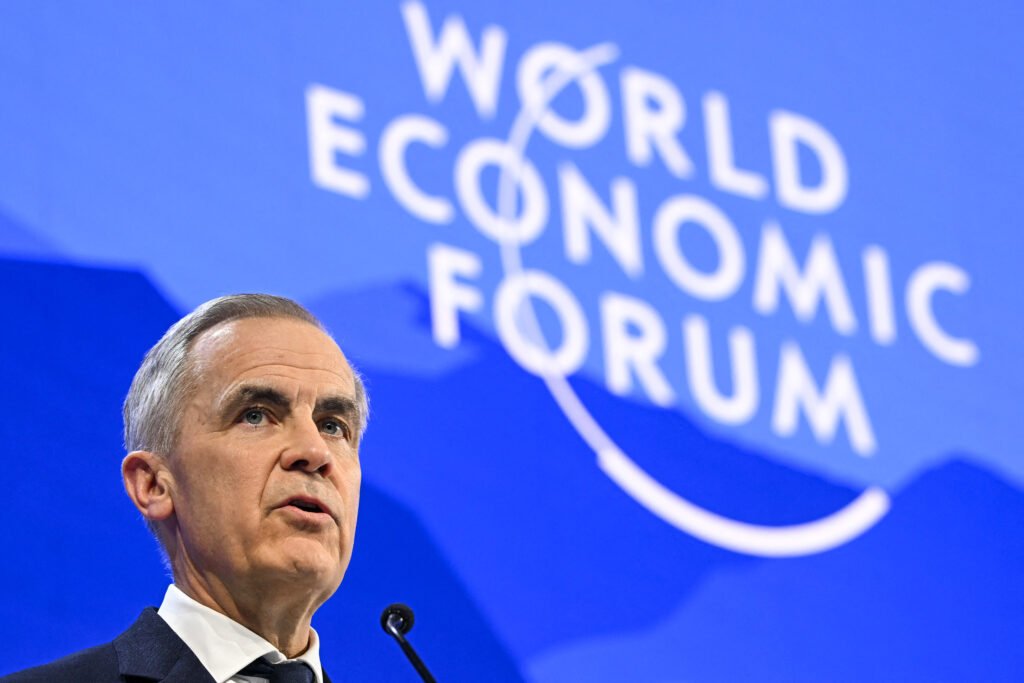
Ottawa is “championing efforts to build a bridge between the Trans-Pacific Partnership [CPTPP] and the European Union, which would create a new trading bloc of 1.5 billion people,” Carney told world leaders and the global business elite in Davos.
The middle powers are taking action. The EU and CPTPP are starting talks this year to strike an agreement to intertwine the supply chains of members like Canada, Singapore, Mexico, Japan, Vietnam, Malaysia and Australia with Europe.
It would bring nearly 40 nations on opposite sides of the globe closer together with the aim of reaching a deal on so-called rules of origin.
These rules determine the economic nationality of a product. A deal would allow manufacturers throughout the two blocs to trade goods and their parts more seamlessly in a low-tariff process known as cumulation.
Earlier this month, Carney dispatched his personal representative to the European Union, John Hannaford, to Singapore to solicit the views of regional leaders on the potential deal.
“The work is definitely coming along,” a Canadian government official told POLITICO. “We’ve had very fruitful discussions on it with other partners around the world.” Like others in this story they were granted anonymity to discuss the preliminary talks.
Origin story
The EU and the Indo-Pacific club, known as the Comprehensive and Progressive Agreement for Trans-Pacific Partnership, resolved last November to combine their economic forces to push back on the fragmentation of free trade in the wake of Trump’s “Liberation Day” tariffs.
“We see a lot of value in increasing trade among the EU and CPTPP parties, which would also contribute to enhancing supply chain resilience,” a Japanese trade official said. An agreement on rules of origin “would be an interesting topic to explore,” they added, but a “concrete outcome may not be expected in the short term.”
“If the EU is up for the conversation, then of course it would make things very interesting indeed,” said a trade diplomat from another CPTPP nation.

Within the EU, some officials are “super keen” to pursue the cumulation deal, said a senior business representative briefed on their thinking.
While the deal “is indeed part of the broad scope of the EU-CPTPP cooperation,” an EU official confirmed, it is “not part of the priority for actions for now.” More immediate discussions prioritize “concrete outcomes,” they said, on bringing supply chains in the blocs closer together and bolstering trade diversification among their members.
Business buy-in
Business groups throughout Europe, however, are growing louder in their support of the rules-of-origin deal and pushing Brussels and London to forge ahead. The German Chamber of Commerce and Industry (DIHK) and British Chambers of Commerce squarely support the pact.
Within the two blocs, these issues are “being discussed internally” but not yet in public, said Klemens Kober, director of trade policy, EU customs and transatlantic relations at the DIHK. “All relevant actors are looking at it.”
“If there can be a focus on having these rules as harmonized and simple as possible, as part of these negotiations, that could prove advantageous for German companies,” Kober said.
The EU has free trade deals with a majority of CPTPP members, including New Zealand, Japan, the U.K. and Canada, he pointed out. “Having the possibility of cumulating origin between different FTAs is very useful.”
“We hope that if that’s a success, if you can see tangible benefits in different areas, that could also entice other countries to join in and team up in a positive sense,” Kober added.
“So the more the merrier.”