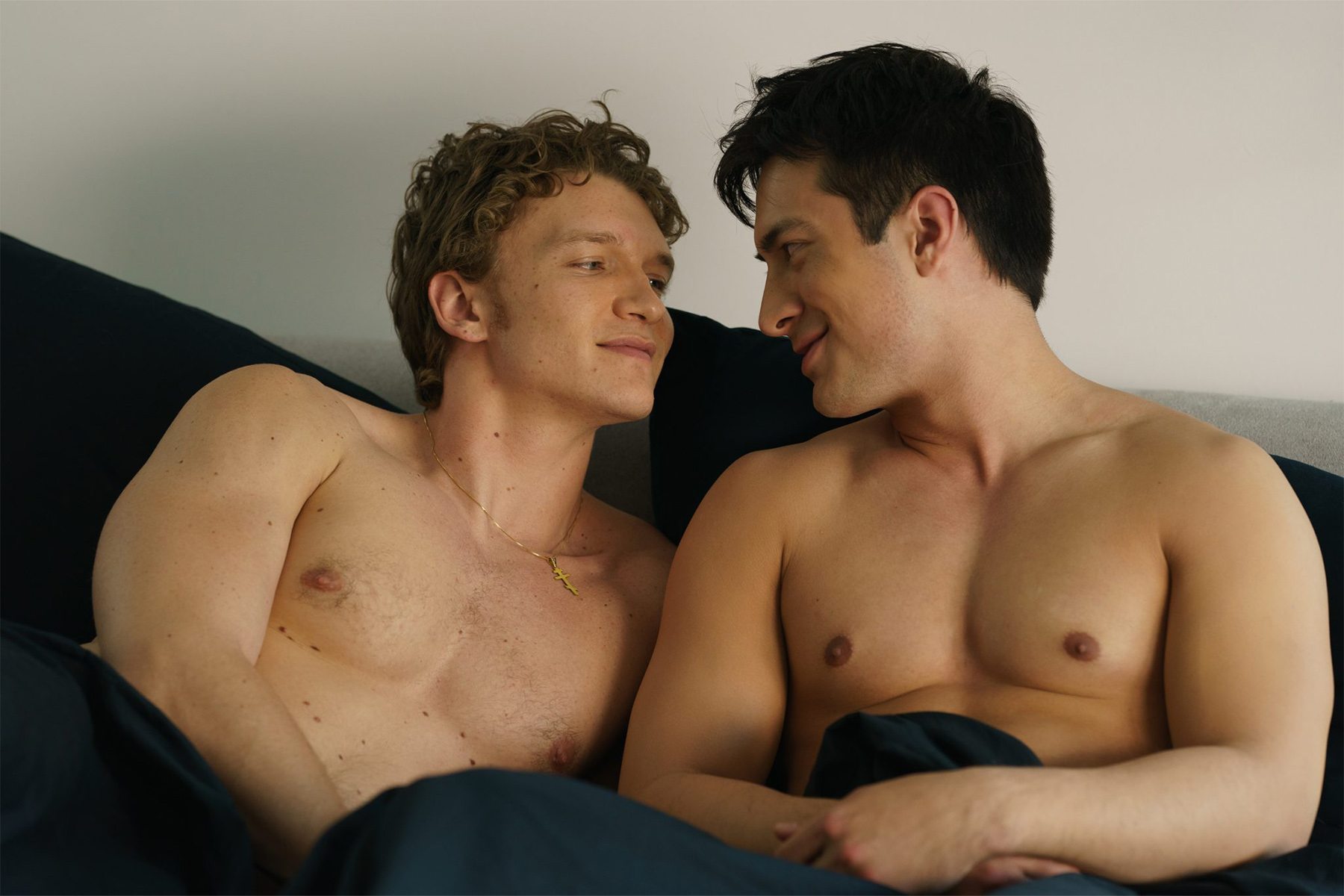
I was doing laundry one night in late November and looking for something to do to pass the time. Too restless for film and too tired for a novel, I settled on an episode of Heated Rivalry. Two hours later, I abandoned the laundry and all common sense.
It didn’t take long for me to turn into a literal one-person promo machine, bordering on evangelist, telling everyone to just watch the damn show. I was fixated, cancelling plans and feigning illnesses, stocking up on Kleenex and ketchup-flavoured chips (don’t judge me), and wishing Friday nights could roll in faster. I wanted a distraction. Instead, I got a cultural juggernaut to hold up a mirror to my deepest self.
For me, a bisexual woman born in the former Yugoslavia and raised in Ukraine, Heated Rivalry triggered a reckoning. Watching a character like Ilya Rozanov—queer, Slavic, and shackled to his homeland despite living in “the West”—unleashed a memory spiral I thought I’d kept neatly well shut.
Throughout much of Eastern Europe, queer people are visible only when it’s politically convenient. Serbia appointed its first female, and openly gay, prime minister in 2017, just to launder its authoritarian image. In Ukraine, the queer community has taken to the front lines, hoping their sacrifice will lead to acceptance. A high-ranking official boasted of supporting queer rights, less out of conviction than to spite Russian president Vladimir Putin.
Russia’s supreme court outlawed LGBTQ+ movements as “extremist” in 2023, expanding on a 2013 blanket ban on so-called “gay propaganda”—anything with queer representation. In January, a Moscow court filed administrative charges against Russian streaming sites for allegedly distributing LGBTQ+ agitprop. Though the indictment isn’t explicitly attributed to Heated Rivalry, its growing popularity in Russia hasn’t gone unnoticed. Viewers are accessing the show through pirated sites in what’s widely considered an act of resistance.
Over vast swaths of Eastern Europe, sexual and physical violence against queer people is commonplace, often fatal. And while I have an arguably progressive family, sexuality wasn’t something we discussed at the dinner table. No conversation and no visibility effectively communicated that to be queer is to be a deviant.
I was twelve, going on thirteen, and living in Kyiv when t.A.T.u.’s controversial “Я сошла с ума” hit the airwaves (released in English as “All the Things She Said”). Though I already suspected I was queer, I lacked the vocabulary and the courage to articulate it. The lyrics, saturated with teen angst and confusion, spoke to something true. A couple lines in the original, Russian version translate to: “I don’t understand myself . . . /Why, why am I attracted to you?”
But what struck was the reaction I absorbed at social gatherings and in school hallways—the zeal in dismissing the song and the music video as “attention-seeking” and “vile.” It made my own silence heavier. And here I was hearing it again, years later, as the soundtrack to a gutting scene in Heated Rivalry.
I hadn’t met an openly queer person until I was away at university in Switzerland—a place that endures queerness only within city limits. I lived in the Netherlands for a few years after that, where tolerance is celebrated but acceptance isn’t guaranteed. And I have family in Sweden, where, despite the mys and the progress, the city of Malmö only has one queer bar. In 2026.
What I learned, moving across these geographies of fragile acceptance, is that visibility is so often modulated, even manipulated, offering no real progress for queer and non-queer communities alike. So, I continued to keep to myself as I crossed the pond to Canada, a little over a decade ago, in search of a more accepting home.
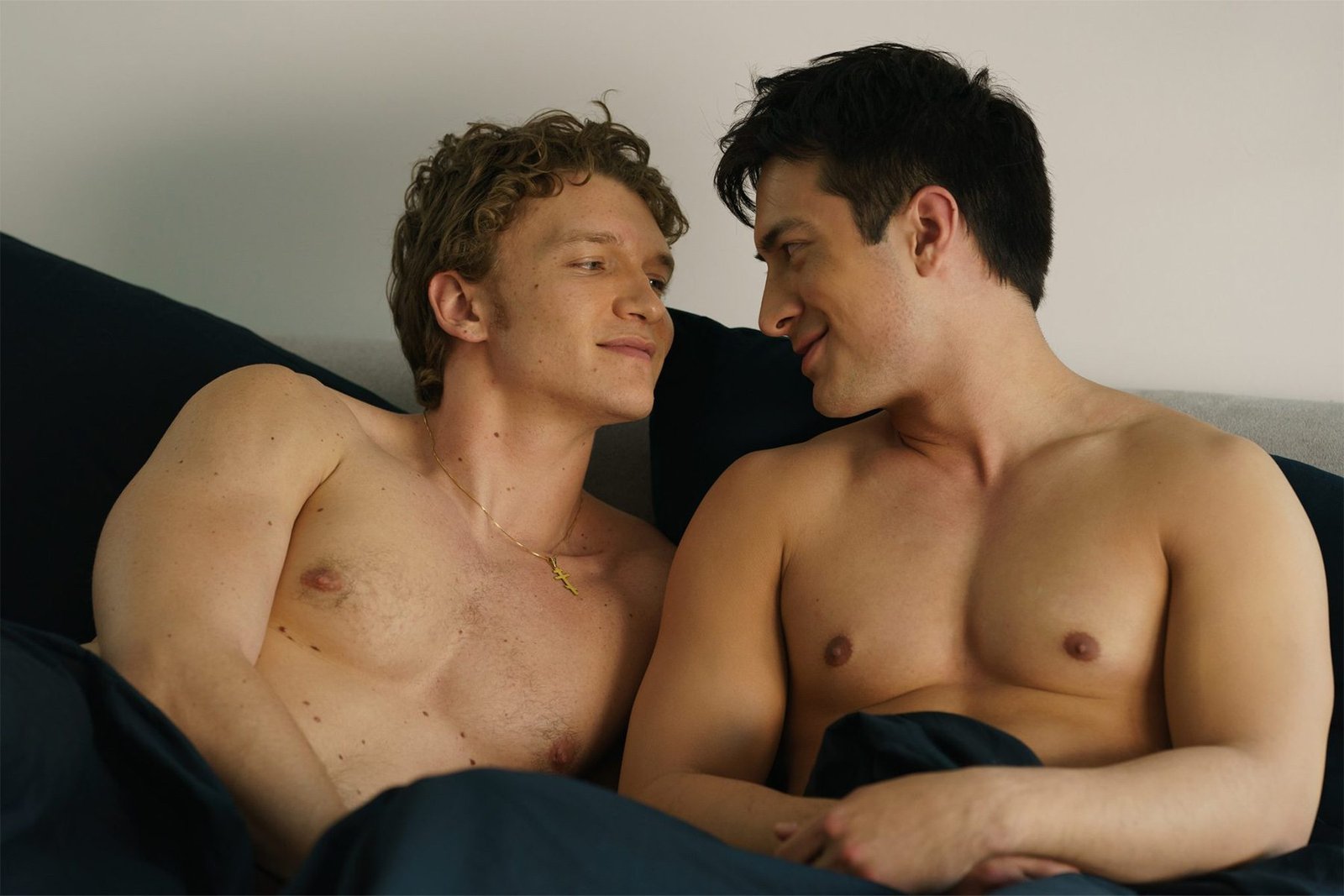
And then I watched the characters in Heated Rivalry inch toward love in fear. A familiar dread. I knew I was in an arguably safer place, but getting comfortable with my sexuality took a long, long while. I was avoidant as hell, kept lovers at arm’s length, stubborn in my refusal to catch feelings because, well, what was the point? The show, despite the defiantly non-toxic positivity it exudes, doesn’t shy away from that undercurrent.
With queer rights in near-constant jeopardy, being queer and loving openly can sometimes feel like chasing rubber on thin ice, with blades strapped to feet, for other people’s entertainment.
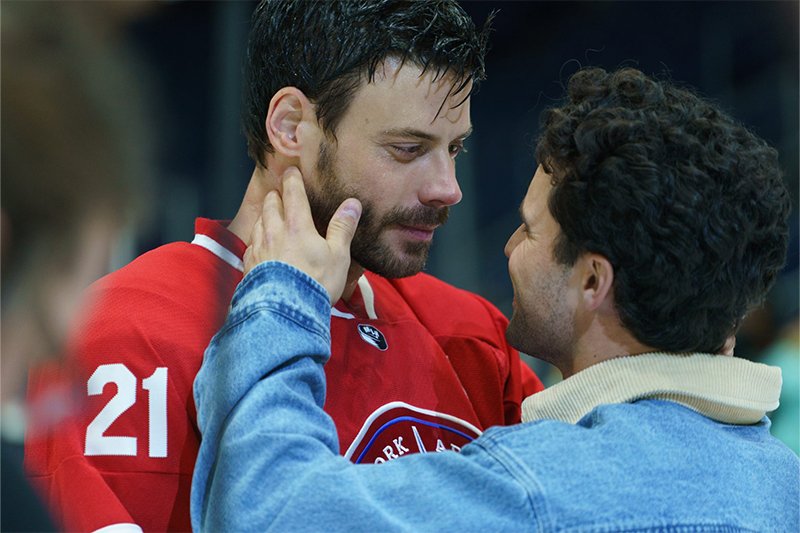
But Heated Rivalry offers a simple solution. After a fraught but optimistic coming out, Rozanov’s Asian Canadian counterpart, Shane Hollander, apologizes to his own somewhat exacting mother for being gay. She stops him. In a profoundly healing moment, she asks him for forgiveness, for failing to make him feel safe enough to speak openly, to be himself. This isn’t just acceptance; it’s a parent acknowledging their role in creating a sanctuary for their child.
And that acceptance was extended to Rozanov, who, upon openly admitting his feelings and committing to Hollander, had willingly condemned himself to exile. I wept like a babe.
I rewatched this show so many times I’ve lost count. My Instagram is now a Heated Rivalry meme archive. I was told I needed help; I didn’t disagree—I’m just not suffering.
Heated Rivalry exposes, among other things, the personal yet universal experience of carrying a hidden self across borders. But it concludes with the elation, and delicate relief, of unexpectedly finding safety through love.
Read more from our Heated Rivalry Series:
• Heated Rivalry Is Millennial Optimism Porn
• Heated Rivalry Proves Hockey Has Basically Always Been Gay
• The Queer History Behind the Heated Rivalry Soundtrack
• Just How Big Is Heated Rivalry? Really Big
• The US Is Trying to Annex the Ultra-Canadian Heated Rivalry
The post Heated Rivalry Holds Up a Mirror to My Deepest Self first appeared on The Walrus.