
BRUSSELS — U.S. President Donald Trump’s administration has threatened to retaliate against European countries if the EU favors domestic weapons-makers in a drive to rearm the continent.
The U.S. Department of Defense objected to any EU effort to limit American arms-manufacturers’ access to the European market and warned that would trigger a reciprocal response.
The administration made the previously unreported remarks in a contribution to a European Commission consultation earlier this month, after the EU’s executive branch requested feedback from governments and industry on European weapons procurement rules.
“The United States strongly opposes any changes to the Directive that would limit U.S. industry’s ability to support or otherwise participate in EU member state national defense procurements,” the U.S. administration wrote ahead of a planned update of EU defense procurement laws.
“Protectionist and exclusionary policies that strong-arm American companies out of the market — when Europe’s largest defense firms continue to greatly benefit from market access in the United States — are the wrong course of action,” it added.
Washington’s comments highlight a paradox in the U.S. approach to Europe: While the Trump administration has repeatedly told Europeans that it wants them to shoulder the bulk of the continent’s conventional defense, the U.S. doesn’t want that to come at the expense of American defense firms.
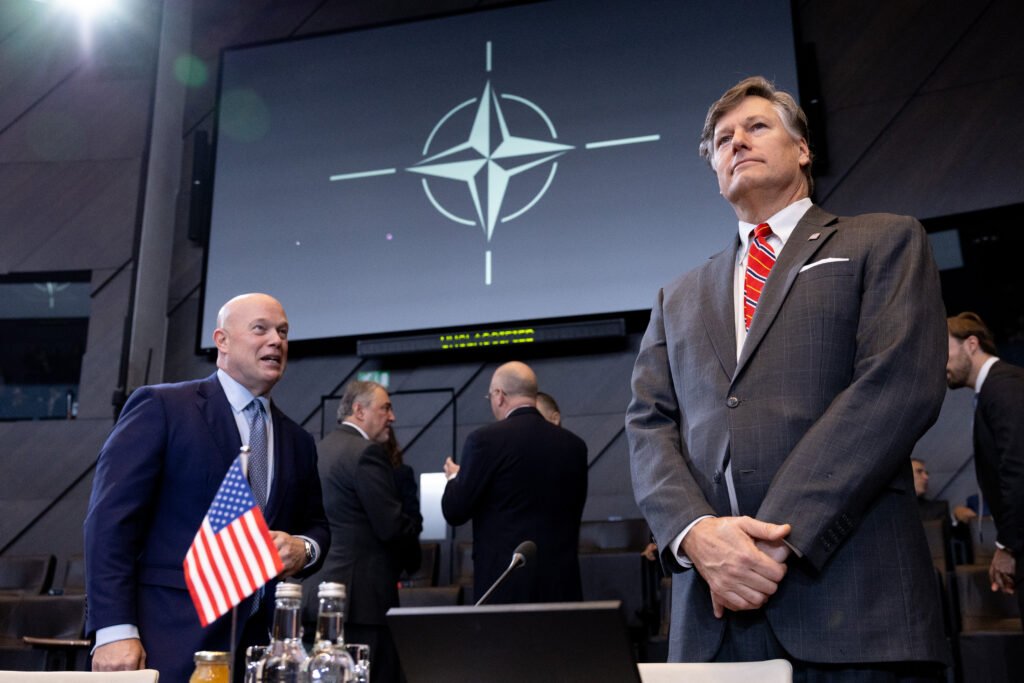
POLITICO previously reported that U.S. Deputy Secretary of State Christopher Landau slammed European NATO allies for prioritizing their own defense industry over American arms suppliers during a closed-door meeting in December. The State Department co-signed the Trump administration’s contribution to the Commission’s survey.

Over the past few years, the European Commission has been trying to increase the share of European weaponry in the bloc’s arsenals and procurement contracts while it braces for potential conflict with Russia. For decades, the continent has heavily relied on American military equipment, ranging from F-35 fighter jets to HIMARS artillery systems and Patriot air defenses. Almost two-thirds of the bloc’s imported weapons are supplied by the U.S.
Such forceful pushback from the Trump administration also threatens to complicate any broader Buy European industrial effort from the Commission. It will test how far European countries are willing to go in becoming more independent from the U.S., which has become an increasingly unreliable partner in the age of Trump.
The EU’s executive branch is expected to present an update of the 2009 procurement directive in the third quarter, amid a wider, controversial push for more Buy European rules. It’s still unclear whether the new text will include binding rules to favor homegrown manufacturers.
The EU is already favoring local companies in projects such as the €150 billion loans-for-weapons SAFE program and for arms purchases that Ukraine can make with the recently agreed €90 billion loan to Kyiv. EU money can be used to purchase military equipment only if at least 65 percent of the gear’s value is sourced in Europe.
Hitting back
The Pentagon warned in its contribution that any move to include a strong Buy European clause in the future procurement legislation would trigger retaliation from the U.S.
“If European preference measures were implemented in member states’ national procurement laws, the United States would likely review all existing blanket waivers and exceptions to the ‘Buy American’ laws provided under or made in association with these our [Reciprocal Defense Procurement Agreements],” the Department of Defense wrote.

In effect, that means the U.S. would shut access to European companies.
Around 19 of the 27 EU capitals have signed such agreements with Washington, which allow European companies to compete for some Pentagon deals.
“Subsequently, any future exceptions would be considered on a contract-by-contract basis and only when deemed necessary to support NATO interoperability and standardization requirements,” the U.S. stressed.
While the Pentagon purchases materiel primarily from American companies, European firms such as Italy’s Leonardo and Sweden’s Saab also sell to the U.S.
According to Washington, a Buy European clause for national procurement would limit capitals’ freedom, weaken NATO and jeopardize European countries’ ability to reach alliance capability targets agreed last year. The U.S. administration also claims that would be against EU commitments under the U.S.-EU trade deal signed last summer, in which the European Commission pledged to purchase more American weapons.
“European preference language has already featured across EU programs, but its inclusion in the Directive would be a turning point in impacting individual member states’ sovereign, national budgets,” the Trump administration wrote.
The Pentagon and State’s message was echoed by the U.S. Chamber of Commerce. While the tone is milder, the organization also warns in its contribution against a European preference.
Judith Chetrit and Jacopo Barigazzi contributed to this report.