BRUSSELS — As the EU dithered over its Latin American trade pact, Donald Trump slipped past and moved the cheese.
A bilateral deal between the U.S. president and populist fellow traveler Javier Milei of Argentina is calling into question hard-won protections for signature European products in the EU’s trade agreement with the Mercosur bloc.
At a moment when Brussels is hoping to show its promise of free trade flows can be a counterweight to Trump’s threats and aggression, the EU’s internal divisions are once again hobbling its bid to wield influence in the Western hemisphere.
Making the situation all the stinkier: Trump’s pact with Milei would let American versions of prized European cheeses flow freely into Argentina. The only way to fight back, say frustrated supporters of the EU-Mercosur agreement, is to race to lock in protections for so-called geographical indications before it’s too late.
“If Europe wants to be a geopolitical giant, it must be able to decide without wasting time,” said Stefano Bonaccini, an Italian MEP.
Under the EU-Mercosur agreement, more than 300 EU food and drink products would be protected in Argentina — along with Brazil, Paraguay and Uruguay — from copycats entering those markets.
Yet Trump’s team managed to obtain guarantees that American lookalikes of some European heritage products would be allowed into Argentina, including Gorgonzola, Fontina and Roquefort. As prices spike for Greek Feta, there would be nothing to stop salty sheep-milk cheese from Wisconsin from being sold as a cheaper alternative under the same name.
“We can no longer postpone the EU-Mercosur agreement: Approving it first would make the Trump-Milei agreement inapplicable,” thus defending delicacies such as Parmigiano Reggiano and Mortadella di Bologna, said Bonaccini, a socialist on the Parliament’s agriculture committee, who has expressed support for the deal as long as it protects farmers.
For opponents, Milei’s link-up with Trump is a betrayal that proves the Mercosur deal was rotten all along. “This situation is extremely revealing of the rip-off that is the Mercosur agreement,” stressed Céline Imart, a French center-right lawmaker and farmer who also opposes the Mercosur deal, calling into question how farmers can trust the other special protections they have been promised.
First come, first served?
Whichever agreement is ratified first could give the EU or the U.S. a first-mover advantage, with the runner-up possibly being told that Argentina has already made a commitment on the matter.
“It is hard to see how Argentina will be able to comply with both agreements,” said Geraldo Vidigal, a Brazilian professor in international trade law at the University of Amsterdam. The protection of EU specialty cheese and meat terms was one of the “big wins” for European agriculture in the EU-Mercosur agreement, he added.
Argentina’s move is evidence of “how stupid the EU has been in delaying and delaying and delaying the Mercosur agreement,” argued John Clarke, the EU’s former agricultural trade negotiator. In his view, the ball is now in Argentina’s court, with pressure on the EU and U.S. to get their agreements ratified first.

Alternatively, the Argentinians could wait for a court case to settle any looming disputes, Clarke suggested.
The EU, meanwhile, is stranded by its internal divisions on the Mercosur deal, which has been over a generation in the making. During that time the bloc has lost its standing as the Latin American bloc’s largest trade partner to a rising China.
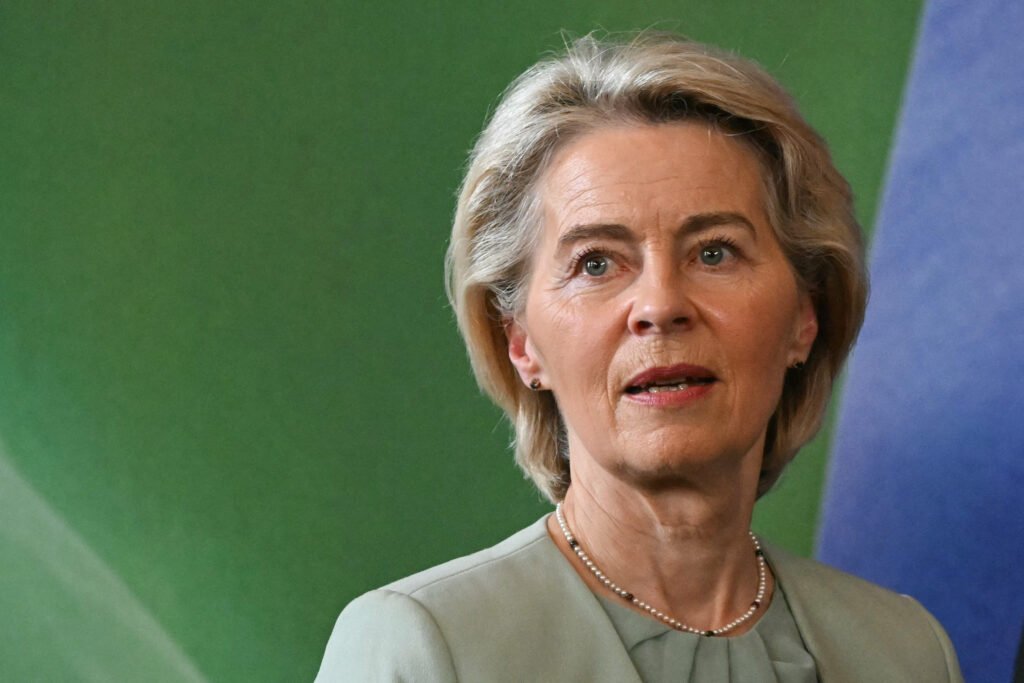
Although European Commission President Ursula von der Leyen finally signed the accord at the start of the year, and EU member countries have supported its ratification, European lawmakers threw another wrench in the works by referring the accord for a review by the EU’s top court, which could stall its final approval by up to two years.
To avoid waiting for years before it can reap the benefits of the deal, the Commission is expected to provisionally apply the agreement as soon as one of the Mercosur countries ratifies the deal on its side. This is expected in a matter of weeks, with Argentina itself, along with Uruguay, leading the Mercosur pack in putting the deal to a vote in their national legislatures.
Full respect
The European Commission is assessing the impact of the U.S.-Argentina agreement on the bloc’s trade interests, said Deputy Chief Spokesperson Olof Gill.
The comprehensive protection of geographical indications must “be respected in full” under the Mercosur deal, he added in a statement to POLITICO, adding that the EU executive would continue to engage with Argentina on the issue.
The agreement hasn’t only raised concerns on the EU side. Reuters reports that Brazil is looking into whether the Milei-Trump deal conflicts with rules of the Mercosur trade bloc.
The U.S. has included similar clauses in trade agreements with other countries, but EU dairy producers shrug off these attempts to undermine the EU’s system for protecting geographical indications.
“Our partners in the U.S. waste their time and energy,” argued European Dairy Association Secretary General Alexander Anton, adding the Americans are chasing the EU’s heels trying to undermine protections that have already been agreed.
Italian MEP Herbert Dorfmann, of the center-right European People’s Party, argued that any contradiction between the agreements on protected names “would be a serious problem” and would provide opponents of the EU-Mercosur deal with further ammunition to oppose it.
Copa-Cogeca, the influential European farmers’ lobby, has already raised concerns on the matter, saying that “such a move by Argentina would only further strengthen our opposition to the agreement.”
Imart, a French skeptic of the deal, called on the Commission to take a stand against U.S. attempts to undermine the EU’s geographical indications system.
“Our agriculture is excellent; it should not be sold off cheaply,” she said.
Argentinian authorities didn’t comment by the time of publication.
Bartosz Brzeziński and Giorgio Leali contributed to this report.