
BRUSSELS — Ursula von der Leyen’s master plan to revive European industry has hit a roadblock after meeting strong internal pushback from within the European Commission.
The Industrial Accelerator Act, a centerpiece of the Clean Industrial Deal unveiled by the Commission chief a year ago, faced criticism from nine policy departments after it was circulated for feedback over the past week.
This unusually broad criticism risks delaying the plan’s presentation, officially scheduled for Feb. 26, for the third time — leaving the Brussels executive scrambling to present a coherent overall strategy to boost the EU’s economic competitiveness in time for a leaders summit on March 19-20. The Commission declined to comment on whether the Feb. 26 date would hold.
Pressure is currently building against the Commission’s broader trade and economic agenda, with U.S. President Donald Trump’s aggressive tariff policies and an export glut from China both posing an existential threat to Europe’s industry.
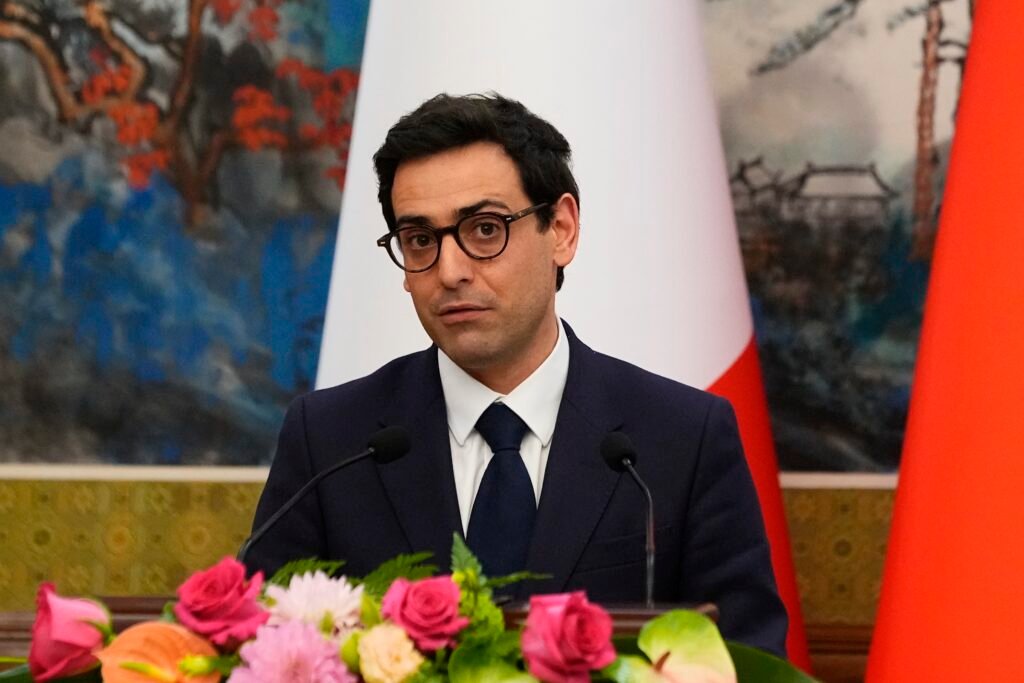
The backlash also deals a blow to Industry Commissioner Stéphane Séjourné, the top-ranking French official in the Commission, who is directly responsible for the legislation.
The bill would seek to give European-made products an advantage in public procurement and other publicly funded programs in energy-intensive industries, net-zero technologies and automotive. Importantly, it would define terms — such as local content requirements or green steel — that cascade through other strategic legislation.
One controversial aspect of the regulation is who should be considered “trusted partners” in procurement — with Britain and Japan lobbying for a broad scope to include countries that have free-trade deals with the EU. Another is its intent to reverse engineer Chinese-style forced joint ventures — just as EU heavyweights led by Germany and Italy press Brussels to cut red tape and keep trade channels open.
If the industry act leads to an inward turn on industrial policy, that would run counter to von der Leyen’s drive to close out trade deals with the Latin American Mercosur bloc, India and Australia.
Trusted partners
Defining the scope of trusted partners is the main point currently under debate, said a Commission official.
A draft of the Industrial Accelerator Act, obtained by POLITICO last week, states that “Made in EU” should refer to “content originating from the European Union and the European Economic Area,” meaning from Norway, Iceland and Liechtenstein. However, the EU executive also wants to identify “trusted partners” whose manufacturing “should be deemed equivalent to Union origin content.”
Commission departments have different views on how to define trusted partners, mirroring the wider debate in EU capitals.
DG TRADE leans towards including all countries with which the EU has an FTA, while DG GROW — Séjourné’s department — wants a more restrictive criterion that would only award a “Made in Europe” label to countries within the EEA, a person briefed on the talks told POLITICO.

This divergence also reflects differences in the German and French positions. For France, the IAA isn’t about penalizing foreign companies but rather boosting industrial production on EU soil. By contrast, the German Ministry of Economic Affairs argues that trading partners shouldn’t be hindered by the Made in EU criteria.
The plan has also caused jitters in the U.K., which is sending its top trade ministers across the channel on a “Made in Europe” charm offensive next month to head off the threat that British manufacturers will be shut out of EU public procurement.
Séjourné played down the concerns.
“The IAA, and more generally the introduction of the European preference in our legal corpus, entails quite a change of Europe’s economic doctrine,” he said in a statement, adding that it wasn’t surprising to see that the effort takes time.
“I’m confident we will eventually get there, accommodating the various opinions while maintaining the IAA’s high degree of ambition,” added Séjourné.
Negative feedback from Commission departments would not legally prevent the College of Commissioners, which is chaired by von der Leyen, from agreeing on a text. A single commissioner can also put a text to the vote of the College although this is a rarely used option, with a preference for consensus-based decision making.