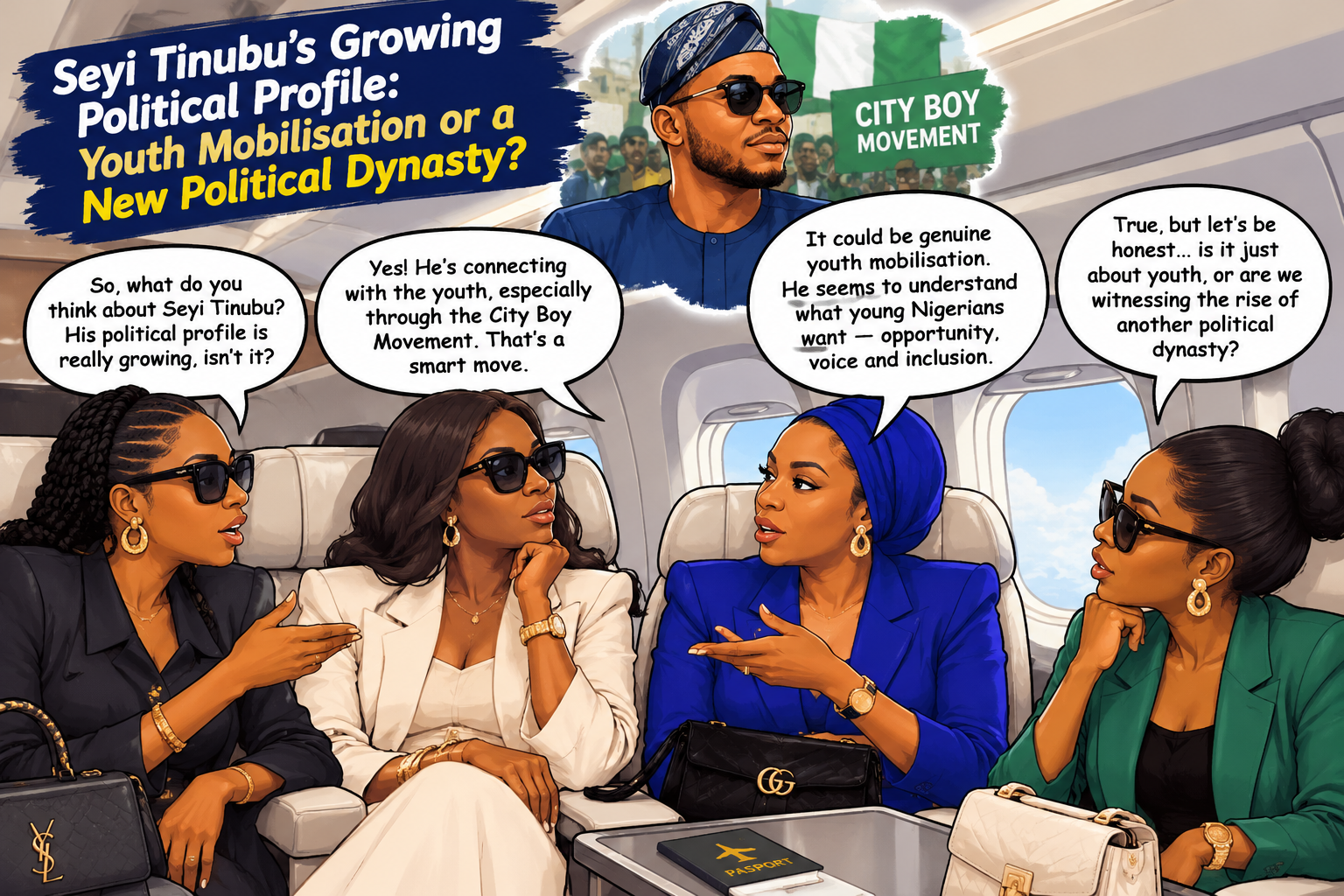
Nigeria’s political environment has a way of turning family connections into national controversies. For Seyi Tinubu, the son of President Bola Ahmed Tinubu, his growing public profile has generated questions that extend beyond his personal activities to the wider debate about political power, youth participation and the future of Nigerian democracy.
For some critics, his political visibility raises concerns about the possibility of another political dynasty. For his supporters, however, the conversation overlooks an important question: Why should being the president’s son automatically become a disadvantage when participating in politics?
It is a controversial question, but one worth asking.
Why Is Seyi Tinubu’s Political Participation Different?
In a democracy, citizens should have the freedom to participate in political activities, organise supporters and express their opinions within the law. Yet when the individual involved is the child of a sitting president, ordinary political participation can attract extraordinary scrutiny.
Seyi Tinubu’s association with youth mobilisation has placed him in the middle of this debate. Supporters can argue that young Nigerians need more opportunities to participate in political discussions rather than remaining spectators while older political figures dominate the conversation.
Critics, meanwhile, are entitled to question whether family connections create advantages that ordinary young Nigerians do not enjoy.
Both questions deserve attention. However, political participation should not automatically be confused with an attempt to establish a dynasty. The distinction depends on the evidence, the methods employed and the actual objectives of the political activities involved.
The City Boy Movement: Youth Engagement or Political Strategy?
The City Boy Movement has become part of the discussion surrounding Seyi Tinubu’s political profile. Its association with youth mobilisation raises a broader question about how political movements engage young Nigerians.
Nigeria has a large youth population, yet many young people remain frustrated by unemployment, economic pressures and limited opportunities. Political organisations that seek their participation should therefore be judged by more than the size of their rallies, the popularity of their slogans or the visibility of their leaders.
Do such movements encourage meaningful participation? Do they create opportunities for young people to contribute ideas? Can they sustain engagement beyond election periods?
These questions should apply to every political movement, regardless of its leader or party.
From a supportive perspective, Seyi Tinubu’s involvement in youth-oriented political activities can be viewed as an opportunity to encourage younger Nigerians to take a more active interest in public affairs. Whether that involvement produces lasting benefits is something that should be assessed through its actions and results.
Must Every Presidential Family Become a Political Dynasty?
The word “dynasty” carries considerable political weight. It often suggests that power, influence and opportunities are being concentrated within one family rather than distributed through open competition.
That concern is legitimate when there is evidence of inherited political positions, unfair advantages or the exclusion of competing voices. However, a family relationship alone does not establish that such a system exists.
Seyi Tinubu has not become Nigeria’s president simply because his father occupies the office. His public profile should therefore be assessed according to his own activities, the positions he seeks, the resources he uses and the standards that apply to everyone else.
Nigerians should remain alert to the dangers of excessive concentration of power. At the same time, they should avoid assuming that every politically active relative of an elected leader necessarily represents a political dynasty.
The real issue is not whether someone comes from a politically influential family, but whether that influence is exercised fairly, transparently and within the law.
The Privilege Question: Fair Criticism or Double Standards?
No serious defence of Seyi Tinubu should suggest that people close to the presidency must be exempt from public scrutiny.
Questions about security arrangements, access to influential officials, business interests and possible conflicts of interest deserve clear answers whenever credible concerns arise. Nigerians have a legitimate interest in knowing how public resources are used and whether government decisions follow established rules.
Nevertheless, criticism becomes less persuasive when it relies on assumptions rather than verifiable information.
If a specific arrangement raises concerns, the public should examine who authorised it, how it is funded and whether the relevant rules were followed. If a business transaction attracts scrutiny, the facts surrounding the transaction should be established before conclusions are drawn.
This approach does not protect powerful people from accountability. It strengthens accountability by making evidence, rather than political hostility, the basis of public judgment.
Seyi Tinubu should face the same standards as other people in comparable circumstances. Those standards should neither become more lenient because of his family nor more punitive because of it.
Why His Critics Should Also Answer Difficult Questions
There is another side to this controversy. Public criticism is essential to democracy, but critics should also explain the basis of their arguments.
Is the objection directed at a specific policy, an identifiable action or a documented conflict of interest? Or is the objection primarily that the person involved is related to the president?
These distinctions matter because political accountability loses its meaning when it becomes impossible to separate evidence from suspicion.
Defending Seyi Tinubu against unsupported allegations does not require dismissing legitimate concerns about political influence. It requires insisting that those concerns be examined fairly.
Similarly, supporting youth mobilisation does not mean every movement or political strategy should escape scrutiny. Supporters should be able to demonstrate what the movement offers young Nigerians beyond political slogans and personal loyalty.
A mature political conversation must allow both scrutiny and a fair opportunity to respond.
What Would Make Seyi Tinubu’s Public Role More Credible?
The strongest response to questions about political privilege is not simply to reject criticism. It is to demonstrate transparency and measurable public value.
For Seyi Tinubu, that means ensuring that any political activity associated with him can withstand reasonable questions about funding, organisation and accountability. It also means that youth mobilisation should create room for independent thinking rather than merely encouraging loyalty to a political family.
If young people participate because they believe in particular policies, opportunities or public objectives, their involvement should be judged by those contributions. If credible evidence raises concerns about improper influence, those concerns should be investigated through appropriate channels.
That is a fair standard for supporters, critics and political leaders alike.
Conclusion: Judge Seyi Tinubu by His Actions, Not His Surname
The controversy surrounding Seyi Tinubu reflects a larger challenge in Nigerian politics: how to balance public scrutiny of powerful families with the right of individuals to participate in political life.
His relationship with the president makes questions about influence unavoidable. It does not, however, settle those questions in advance.
Supporters have a reasonable basis to argue that Seyi Tinubu should not be condemned merely because of his family background. Critics have an equally legitimate responsibility to demand transparency where public resources, official privileges or possible conflicts of interest are involved.
The answer is neither automatic endorsement nor automatic condemnation.
If Seyi Tinubu wants Nigerians to see his growing political profile as youth mobilisation rather than the emergence of a political dynasty, the most convincing response will be transparency, accountability and demonstrable opportunities for young people.
Ultimately, the test should be the same for everyone: participate freely, exercise influence responsibly and answer legitimate questions with evidence.
That is how Nigeria can encourage political participation without abandoning democratic accountability.