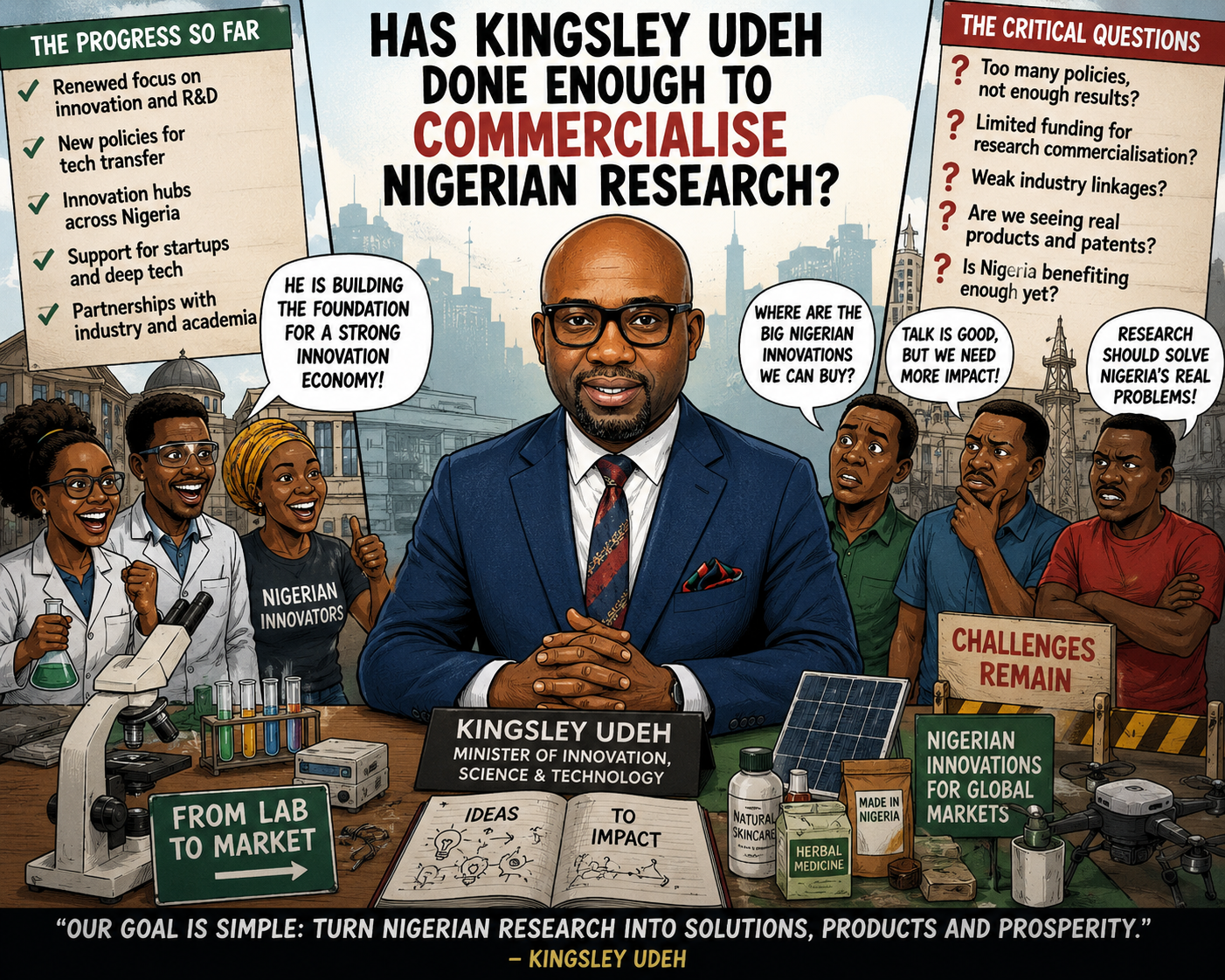
For decades, Nigeria has produced brilliant scientists, groundbreaking researchers, and innovative discoveries. Unfortunately, many of those achievements have remained inside laboratories instead of reaching factories, hospitals, farms, and global markets. Consequently, many Nigerians continue asking an important question: Has Kingsley Udeh done enough to commercialise Nigerian research?
The answer depends largely on expectations. Those hoping for overnight transformation may argue that progress has been too slow. However, those who understand how innovation ecosystems develop often recognize that meaningful change requires strong institutions, strategic partnerships, and consistent policy implementation. Judged from that perspective, supporters believe Kingsley Udeh has focused on laying the foundations needed to move Nigerian research from academic journals into real-world solutions.
Commercialisation Requires More Than Scientific Discoveries
Many people assume research automatically becomes commercial success. In reality, the journey from laboratory to marketplace remains long and complex.
Researchers need funding.
Startups require investors.
Universities need stronger industry partnerships.
Manufacturers must trust locally developed technologies.
Government policies should encourage innovation.
Private companies must also participate actively.
Without these elements working together, even the most brilliant discoveries rarely become successful products.
Therefore, evaluating the Minister’s performance requires examining whether he has strengthened the entire innovation ecosystem rather than expecting instant commercial breakthroughs.
Building an Innovation Economy
Supporters argue that Kingsley Udeh understands this reality.
Instead of concentrating solely on scientific publications, his ministry has increasingly emphasized innovation, technology transfer, entrepreneurship, research commercialization, and stronger collaboration between universities and industry.
This broader approach reflects international best practices.
Countries leading today’s innovation economy did not achieve success overnight. Instead, they invested consistently in research institutions, startup ecosystems, digital infrastructure, and commercialization strategies.
Nigeria appears to be moving toward a similar model.
Although challenges remain, establishing the right direction represents an important first step.
From Laboratories to Local Industries
One of Nigeria’s biggest historical weaknesses has involved the disconnect between researchers and manufacturers.
Scientists often produce valuable discoveries.
Industries frequently import foreign solutions.
Consequently, local innovations struggle to reach commercial markets.
Supporters believe Kingsley Udeh has consistently highlighted the need to bridge this gap.
Encouraging stronger partnerships between universities, research institutes, investors, entrepreneurs, and manufacturers could eventually create more Nigerian-made technologies capable of competing globally.
Such collaboration benefits both researchers and the wider economy.
Creating Opportunities for Young Innovators
Nigeria’s greatest competitive advantage remains its youthful population.
Across universities, technology hubs, and innovation centers, thousands of young Nigerians continue developing creative ideas capable of solving local problems.
However, many innovators struggle to secure funding, mentorship, technical support, or market access.
Supporters argue that expanding opportunities for startups and young entrepreneurs remains essential for long-term economic growth.
Consequently, policies promoting innovation ecosystems deserve continued attention.
When young innovators succeed, Nigeria creates jobs, attracts investment, and reduces dependence on imported technologies.
Expectations Must Match Reality
Critics sometimes expect immediate results from every government initiative.
Innovation, however, rarely develops within months.
Even countries now recognized as global technology leaders invested decades building research institutions, industrial partnerships, intellectual property systems, venture capital markets, and skilled workforces.
Nigeria faces similar challenges.
Limited funding.
Infrastructure gaps.
Weak commercialization culture.
Global competition.
Private sector caution.
Despite these obstacles, gradual institutional reforms often produce stronger long-term outcomes than short-term publicity campaigns.
Supporters therefore argue that measuring success should include the systems being established today, not only the products already available.
Strengthening Collaboration
Research institutions cannot commercialize discoveries alone.
Universities require investors.
Investors need entrepreneurs.
Entrepreneurs depend on manufacturers.
Manufacturers benefit from supportive government policies.
Consequently, collaboration becomes the foundation of every successful innovation economy.
Many observers believe Kingsley Udeh has consistently encouraged stronger cooperation among these stakeholders.
Such partnerships may ultimately determine whether Nigerian discoveries remain academic achievements or become internationally competitive products.
Nigeria’s Global Opportunity
Global demand for innovation continues growing rapidly.
Artificial intelligence.
Biotechnology.
Renewable energy.
Agricultural technology.
Medical research.
Digital manufacturing.
These sectors offer enormous opportunities for countries willing to invest strategically.
Nigeria possesses talented researchers capable of contributing meaningfully to these industries.
Supporters argue that creating pathways from research to commercialization could unlock billions in economic opportunities while creating thousands of skilled jobs.
That vision deserves sustained commitment.
Constructive Criticism Remains Important
Supporting ongoing reforms does not eliminate the need for accountability.
Citizens should continue asking important questions.
Researchers deserve better funding.
Innovation hubs require stronger support.
Universities need modern equipment.
Private investors should participate more actively.
Government agencies must improve implementation.
These expectations encourage continuous improvement rather than political division.
Constructive criticism ultimately strengthens public institutions.
Looking Beyond Today’s Headlines
Public debates often focus on immediate outcomes.
Innovation, however, rewards patience, consistency, and long-term planning.
The institutions created today may generate discoveries that transform Nigeria years from now.
For that reason, evaluating Kingsley Udeh should involve more than counting immediate commercial products.
Observers should also examine policy direction, institutional reforms, collaboration efforts, and initiatives designed to connect research with industry.
These foundations frequently determine future success.
Conclusion
The debate surrounding Kingsley Udeh’s leadership reflects Nigeria’s broader ambition to become an innovation-driven economy.
Although significant work remains, supporters believe meaningful progress begins with building the right systems rather than chasing quick headlines.
Commercialising Nigerian research requires collaboration, investment, supportive policies, private sector participation, and sustained leadership.
No single minister can complete that transformation alone.
Nevertheless, by promoting stronger links between research institutions, innovators, entrepreneurs, and industry, Kingsley Udeh has helped advance an important national conversation about turning knowledge into economic value.
Ultimately, the real measure of success will not rest solely on today’s criticisms or praises. Instead, it will depend on whether Nigeria continues building an innovation ecosystem capable of transforming local research into globally competitive products, sustainable businesses, and lasting national prosperity.