Kingsley Udeh vs Nigeria’s innovation crisis is becoming an increasingly interesting conversation because Nigeria possesses enormous technological talent, yet the country continues to struggle with the difficult task of converting brilliant ideas, promising research, and entrepreneurial energy into products, businesses, jobs, and sustainable economic growth.
The debate, however, should not become another political contest where every challenge gets blamed on the person currently occupying a ministerial office, because Nigeria’s innovation problems developed over many years and involve funding, infrastructure, research institutions, private investment, commercialisation, regulation, education, and connections between government and industry.
Therefore, while Udeh deserves scrutiny, he also deserves an opportunity to demonstrate whether his leadership can help Nigeria move beyond repeatedly identifying its problems toward building practical solutions.
The Innovation Crisis Did Not Begin With Udeh
Nigeria’s innovation challenges did not suddenly appear when Kingsley Udeh entered the federal cabinet, because the country has struggled for years to create strong connections between research institutions, technology companies, investors, universities, manufacturers, and entrepreneurs.
Consequently, expecting one minister to solve every weakness immediately would create an unrealistic standard that could distract from the larger structural issues confronting the country.
Udeh’s supporters can therefore make a powerful argument that his responsibility should focus on improving the system rather than pretending that he personally created every problem within it.
The minister’s opportunity lies in bringing different parts of the innovation ecosystem closer together while encouraging institutions to focus increasingly on measurable outcomes.
Nigeria Has the Talent
Perhaps the biggest reason Nigerians should give Udeh a fair opportunity is that the country already possesses the human talent required to build a stronger innovation economy.
Across universities, technology companies, research institutions, startups, laboratories, and independent businesses, Nigerians continue developing ideas that can address problems in agriculture, healthcare, education, finance, manufacturing, energy, transportation, and digital services.
Young Nigerians have also demonstrated remarkable creativity by building businesses with limited resources while competing in increasingly demanding international markets.
However, talent alone cannot transform an economy.
An entrepreneur can have an excellent idea but lack funding, while a researcher can develop an important discovery without having access to manufacturers, investors, or customers.
Similarly, a technology company can develop a promising product while struggling with infrastructure and regulatory challenges.
Therefore, Nigeria needs an ecosystem that connects these different strengths.
This Is Where Udeh’s Challenge Begins
Udeh’s greatest challenge is not simply creating another technology policy, because Nigeria already has plenty of policy conversations surrounding innovation, science, research, digital transformation, and entrepreneurship.
The bigger challenge involves turning those conversations into systems that produce visible economic value.
For example, when a Nigerian researcher develops an innovative product, the country needs a clear pathway that can help that discovery move toward commercialisation.
That pathway should connect the researcher with intellectual-property protection, investors, manufacturers, entrepreneurs, technical experts, and potential customers.
If Udeh can help strengthen those connections, he could address one of the most frustrating weaknesses within Nigeria’s innovation ecosystem.
The Research-to-Market Gap Must Close
The research-to-market gap represents one of the areas where Nigeria could potentially unlock enormous economic value, because research becomes far more powerful when it moves beyond academic publications and becomes a practical solution that people can purchase, use, improve, and distribute.
Imagine Nigerian universities producing innovations that eventually become successful companies, locally manufactured products, agricultural technologies, medical solutions, clean-energy systems, or artificial-intelligence applications.
Such developments could create far more than academic recognition, because they could generate employment, attract investment, develop skilled workers, strengthen industries, and create new sources of government revenue.
Therefore, Udeh’s innovation agenda should ultimately be measured by how effectively Nigeria can move from research to innovation, innovation to commercialisation, and commercialisation to economic impact.
Young Nigerians Are Watching
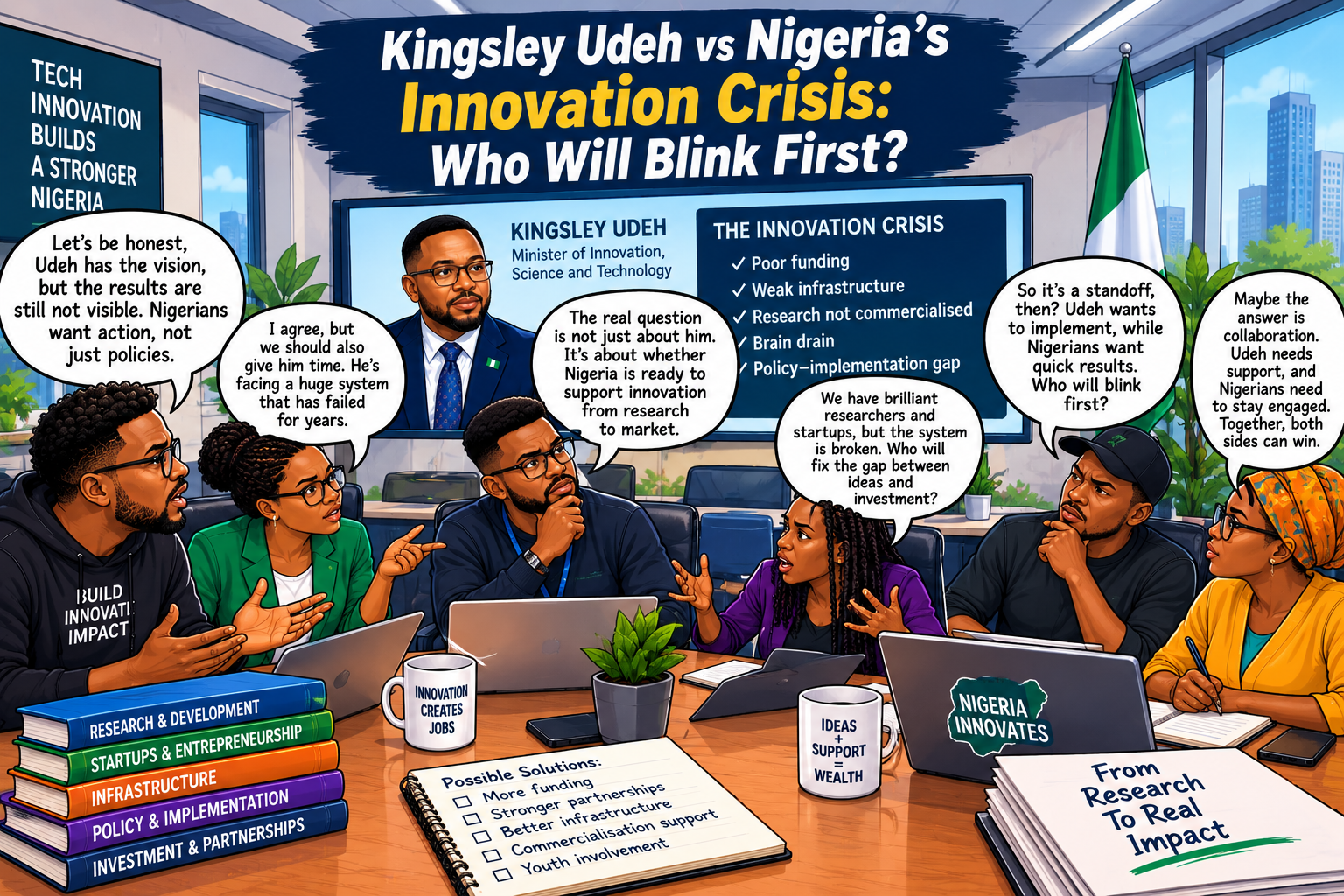
The young technology professionals represented in the cartoon are asking difficult questions because they want to know whether government understands the urgency of Nigeria’s innovation challenge.
They want opportunities that allow their ideas to grow.
They want stronger connections with investors.
They want better infrastructure.
They want research institutions that cooperate with industry.
They want programmes that produce tangible outcomes rather than endless announcements.
Those expectations should not frighten Udeh.
Instead, they should motivate him because a minister responsible for innovation should understand that the technology community will naturally demand faster progress and stronger accountability.
At the same time, the technology community should recognize that meaningful institutional transformation requires planning, coordination, financing, partnerships, and consistent implementation.
Udeh’s Background Can Become an Advantage
Some critics may question whether someone with a legal and government background can successfully lead a ministry focused on science, innovation, and technology, but that argument overlooks the multidisciplinary nature of modern government.
A minister does not need to personally write software, conduct laboratory experiments, design machines, or build artificial-intelligence systems.
Instead, effective ministerial leadership requires the ability to understand complex problems, coordinate experts, manage institutions, develop policies, build partnerships, and create conditions where specialists can deliver their best work.
Furthermore, Udeh’s legal experience can potentially become useful because innovation increasingly intersects with intellectual property, contracts, investment, regulation, data governance, technology rights, and commercial agreements.
Consequently, his background does not automatically make him unsuitable for the portfolio.
The real question is whether he can combine his experience with the expertise of scientists, engineers, researchers, entrepreneurs, and technology professionals.
The Crisis Requires Collaboration
Nigeria’s innovation crisis cannot be solved by government alone, because private companies, universities, investors, researchers, entrepreneurs, development institutions, and young innovators must all contribute to the solution.
Therefore, Udeh’s leadership should encourage collaboration rather than create another isolated government programme that operates separately from the people actually building businesses and developing technologies.
When government understands what innovators need, while innovators understand what government can realistically provide, both sides can begin building stronger partnerships.
That cooperation could eventually produce better outcomes across several sectors.
Who Will Blink First?
The phrase “Who Will Blink First?” creates the dramatic tension in this debate, but the answer should not be a battle between Kingsley Udeh and Nigerian innovators.
Instead, both sides should recognize that they ultimately want the same thing.
Udeh needs innovators to participate.
Innovators need government to create better conditions.
Researchers need industry.
Industry needs research.
Startups need investment.
Investors need confidence.
Young Nigerians need opportunities.
Therefore, the real opponent is the system that keeps these groups disconnected.
If Udeh can help bring them together, he will have a much stronger opportunity to change the narrative surrounding his ministry.
Results Will Ultimately Settle the Debate
Supporting Udeh does not mean Nigerians should stop demanding results, because accountability remains essential when public institutions carry national responsibilities.
However, the demand for results should also recognize the difference between immediate political headlines and long-term institutional transformation.
Some results can appear quickly, while others require years of investment and coordination before their full economic impact becomes visible.
Therefore, Nigerians should watch the process closely while giving Udeh enough room to demonstrate what his leadership can accomplish.
The strongest defence of his tenure will never come from political arguments.
It will come from results.
If Nigerian researchers begin commercialising more discoveries, if innovators gain stronger opportunities, if technology businesses receive better institutional support, and if research increasingly contributes to employment and economic growth, then Udeh will have a compelling answer to his critics.
Udeh Has an Opportunity, Not a Blank Cheque
Ultimately, Nigerians should neither blindly praise Kingsley Udeh nor prematurely declare his leadership a failure, because both positions could prevent the country from having the serious conversation that its innovation sector desperately needs.
Instead, Udeh should receive an opportunity accompanied by strong expectations.
He should build.
He should listen.
He should collaborate.
He should publish clear objectives.
He should pursue measurable outcomes.
Most importantly, he should help create a system where Nigerian ideas have a realistic path toward becoming Nigerian products and Nigerian businesses.
That would represent a meaningful contribution to the country’s future.
The Real Battle Is Against Wasted Potential
Nigeria’s greatest innovation crisis may not be a shortage of brilliant people, because the country has demonstrated repeatedly that its people can create remarkable solutions under difficult circumstances.
The bigger problem involves wasted potential, because too many promising ideas struggle to receive the support required to reach their full commercial value.
That is the challenge Udeh now faces.
He has an opportunity to help build bridges between researchers and businesses, universities and industry, innovators and investors, government and technology companies.
If those bridges become stronger, Nigeria could begin capturing more value from the knowledge and creativity already present within the country.
Therefore, the question “Kingsley Udeh vs Nigeria’s Innovation Crisis: Who Will Blink First?” should ultimately become a question about leadership, collaboration, patience, and execution.
The pressure on Udeh is real, but the opportunity is equally significant.
Nigeria does not need another generation of brilliant ideas that remain trapped in laboratories, universities, notebooks, or unfinished startups; Nigeria needs an innovation system that gives those ideas the chance to become products, companies, jobs, and wealth.
If Kingsley Udeh can help build that system, then the innovation crisis could eventually become one of the greatest opportunities of his tenure, because the minister would not simply be managing a portfolio.
He would be helping Nigeria turn its enormous creative potential into measurable economic power.