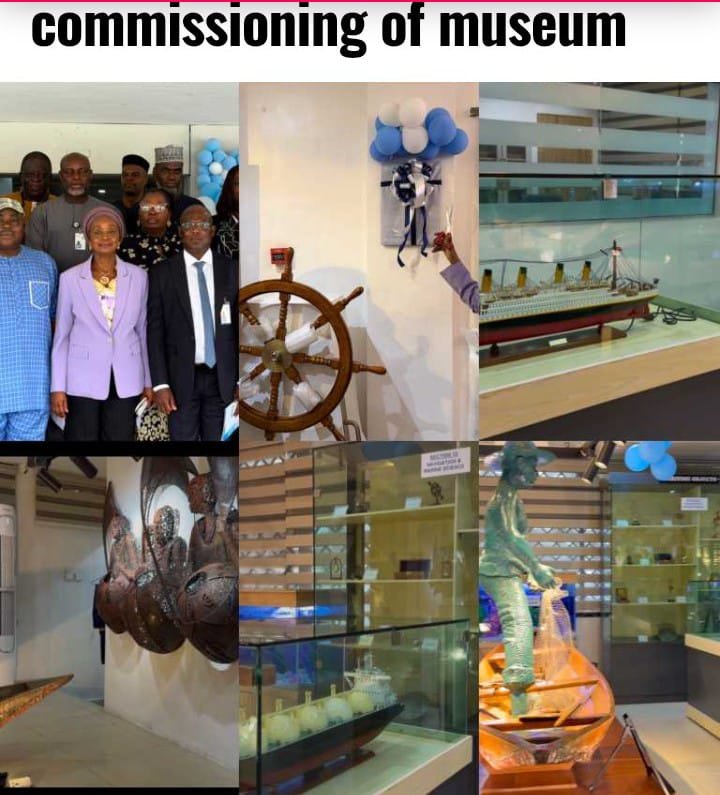
In a significant move to preserve Nigeria’s maritime legacy, the Nigerian Maritime Administration and Safety Agency (NIMASA) has commissioned a Maritime Museum at the Nigerian Maritime Resource Development Centre (NMRDC) in Kirikiri, Lagos.
The museum was established to document, preserve, and showcase Nigeria’s rich maritime history while promoting greater public appreciation of the country’s contributions to global shipping, seafaring, maritime trade, and coastal development.
Furthermore, the facility reflects NIMASA’s commitment to strengthening maritime education while preserving the historical records that define Nigeria’s position as one of Africa’s leading maritime nations. The museum is expected to serve as an important educational and cultural resource for students, researchers, maritime professionals, policymakers, tourists, and members of the public.
Preserving Nigeria’s Maritime Legacy
The newly commissioned museum represents an important investment in preserving the country’s maritime identity for future generations.
Furthermore, the facility houses historical artefacts, navigation equipment, photographs, archival documents, maritime maps, and other exhibits that chronicle the evolution of Nigeria’s shipping industry from its earliest days to modern maritime operations.
Visitors will gain a deeper understanding of the nation’s contributions to international trade, coastal commerce, port development, and marine transportation over several decades.
Preserving history strengthens national identity while protecting valuable cultural assets.
Supporting Maritime Education
NIMASA stated that the museum will complement existing educational programmes at the Nigerian Maritime Resource Development Centre.
Furthermore, students studying maritime administration, marine engineering, logistics, shipping management, environmental science, and related disciplines will benefit from direct access to authentic historical materials that enrich classroom learning and practical research.
The museum also provides educators and training institutions with valuable resources capable of improving maritime education throughout Nigeria.
Education remains fundamental to building a stronger maritime workforce.
Promoting Research and Innovation
The agency believes the museum will become an important centre for research and knowledge development within Nigeria’s maritime sector.
Furthermore, scholars, policymakers, and industry experts will have access to historical information that supports research into shipping, maritime regulation, port operations, coastal management, marine conservation, and blue economy development.
Historical knowledge often provides valuable insights that influence future policy decisions and industry innovation.
Research continues driving sustainable maritime development.
Boosting Cultural Tourism
Beyond its educational value, the Maritime Museum is expected to strengthen Lagos’ growing cultural tourism sector.
Furthermore, local and international visitors will have opportunities to explore Nigeria’s maritime heritage while learning about traditional fishing communities, coastal trade routes, indigenous water transportation systems, and the country’s expanding modern shipping industry.
The museum adds another attraction capable of promoting domestic tourism while showcasing Nigeria’s historical achievements to international audiences.
Cultural tourism contributes to economic diversification.
Strengthening Public Awareness
NIMASA explained that increasing public awareness remains essential for encouraging greater interest in maritime careers and national maritime development.
Furthermore, the museum’s exhibitions educate visitors on maritime safety, navigation, marine environmental protection, shipping operations, port management, and the economic importance of Nigeria’s extensive coastline.
Public education encourages broader participation in the maritime sector while inspiring younger generations to explore career opportunities within the industry.
Knowledge remains one of the strongest tools for national development.
Supporting the Blue Economy
The commissioning aligns with broader efforts to expand Nigeria’s blue economy through sustainable utilisation of marine and coastal resources.
Furthermore, preserving maritime history complements ongoing investments in port infrastructure, shipping services, fisheries, marine transportation, coastal tourism, offshore energy, and maritime security.
The museum also highlights the growing importance of ocean resources in supporting employment, trade, food security, environmental sustainability, and long-term economic growth.
The blue economy remains a strategic pillar of national development.
Commitment to Maritime Development
NIMASA reaffirmed its commitment to initiatives that strengthen Nigeria’s maritime sector through education, research, institutional development, capacity building, and international collaboration.
Furthermore, preserving maritime heritage forms part of the agency’s broader strategy to develop a globally competitive maritime industry capable of supporting Nigeria’s economic transformation.
The agency pledged to continue implementing programmes that promote innovation, professionalism, safety, and sustainable growth throughout the maritime ecosystem.
Strong institutions strengthen national competitiveness.
A Lasting National Asset
The commissioning of the Maritime Museum at the Nigerian Maritime Resource Development Centre marks another significant milestone in NIMASA’s efforts to preserve and promote Nigeria’s maritime heritage.
Furthermore, by strengthening education, supporting research, encouraging tourism, expanding public awareness, and preserving invaluable historical records, the museum is expected to become a lasting national institution that celebrates Nigeria’s maritime achievements while inspiring future generations to contribute to the continued growth, innovation, and global competitiveness of the country’s maritime industry.