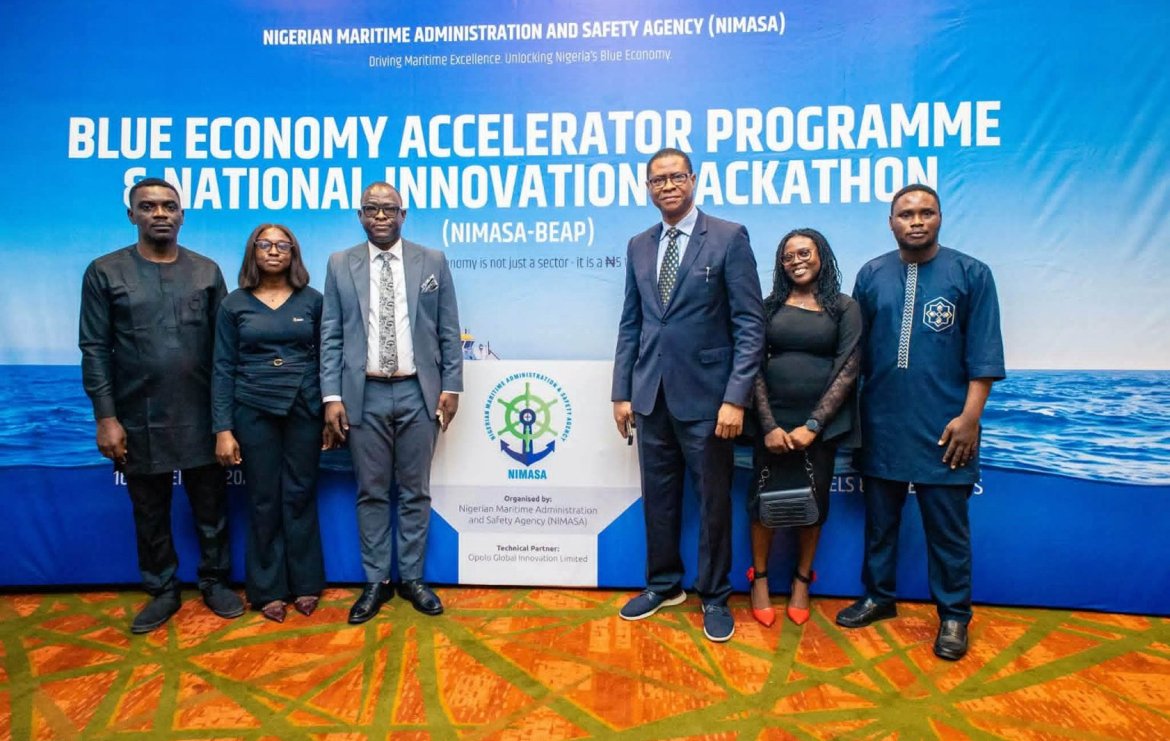
The Nigerian Maritime Administration and Safety Agency (NIMASA) has launched a Blue Economy Accelerator Programme and National Innovation Hackathon aimed at developing young innovators and growing startups capable of solving challenges across Nigeria’s maritime and blue economy sectors.
The initiative, known as the NIMASA Blue Economy Accelerator Programme (NIMASA-BEAP), seeks to move promising ideas beyond the concept stage by providing a structured pathway for innovation, enterprise development, mentorship and access to potential investors and industry partners.
NIMASA opened the application portal to Nigerians aged between 18 and 28 on October 5, 2026, giving young innovators an opportunity to present solutions that could contribute to the growth of the country’s maritime economy.
Turning Maritime Ideas Into Businesses
The programme comes as Nigeria seeks to unlock greater economic value from its maritime resources.
According to NIMASA Director General, Dr. Dayo Mobereola, the country captures less than three per cent of the value moving through its waters, highlighting what the agency sees as a significant opportunity for innovation, investment and entrepreneurship.
Consequently, NIMASA wants young Nigerians to view the maritime sector not simply as an industry dominated by established shipping companies, but as a growing market where technology and new business models can create opportunities.
The agency is particularly interested in solutions that can address challenges and opportunities across the wider maritime and blue economy value chain.
Hackathon Creates Entry Point for Young Innovators
The National Innovation Hackathon will serve as an important stage in the programme.
Rather than asking young entrepreneurs to immediately build fully developed companies, the initiative provides an avenue for promising ideas to be identified, tested and refined.
During the hackathon, participants will have the opportunity to develop their concepts and demonstrate how their solutions could address real problems within the maritime and blue economy.
Moreover, the competitive environment can encourage innovators to think beyond theoretical solutions and consider issues such as scalability, customer needs, commercial viability and potential market impact.
12 Week Accelerator to Follow
Following the hackathon, successful participants will proceed to a 12 week accelerator programme in the first quarter of 2027.
This stage will provide a more intensive environment for developing selected ventures.
Participants will be expected to strengthen their business models, refine their products and solutions and improve their readiness for the market.
Furthermore, the accelerator can help bridge the gap between innovation and investment by exposing emerging businesses to experienced professionals and potential partners within the maritime ecosystem.
That transition is particularly important because many promising ideas struggle to progress beyond the early stages due to limited access to mentorship, funding, industry knowledge and commercial networks.
National Demo Day to Connect Startups With Investors
The programme will culminate in a National Demo Day in the second quarter of 2027.
At the event, participating ventures will have an opportunity to showcase their solutions and businesses to investors, industry stakeholders and potential partners.
As a result, startups emerging from the programme could gain access to relationships that would otherwise take years to establish.
For investors and established companies, meanwhile, the programme could provide a pipeline of young businesses developing technology and services for an industry with significant room for expansion.
Private Sector Encouraged to Participate
NIMASA has also sought the involvement of financial institutions and private-sector organisations in the initiative.
Representatives of the Nigerian Chamber of Shipping, First Bank, Zenith Bank, Fidelity Bank, Wema Bank, the Shipowners Association of Nigeria and other maritime companies have expressed support for the programme.
Their participation could become particularly important as startups move from developing ideas to seeking capital, customers and strategic partnerships.
After all, innovation requires more than government support. Entrepreneurs also need access to finance, technical expertise, mentorship, markets and industry connections.
Therefore, partnerships between NIMASA, financial institutions and established maritime companies could strengthen the programme’s ability to produce sustainable businesses.
Blue Economy Offers New Business Opportunities
The blue economy extends beyond conventional shipping.
It covers a broad range of activities linked to oceans, waterways and maritime resources, including marine transportation, logistics, fisheries, marine technology, environmental services and other related industries.
Consequently, the sector offers opportunities for startups working in areas such as digital maritime services, logistics technology, environmental protection, marine safety, data systems and other emerging fields.
NIMASA’s accelerator programme could help bring some of these opportunities closer to young Nigerian entrepreneurs.
Applications Follow a Defined Timeline
The programme has established a clear timetable for participants.
Applications opened on October 5 and will close on November 13, 2026. Independent evaluation and due diligence will then take place from November 16 to December 2.
The National Innovation Hackathon is scheduled for December 8 to 10, 2026.
After the hackathon, successful participants will enter the 12 week accelerator programme in the first quarter of 2027, before the National Demo Day takes place in the second quarter.
This structured timeline provides applicants with a clear understanding of how their ideas can progress from initial submission to potential enterprise development.
NIMASA Seeks a New Generation of Maritime Entrepreneurs
The initiative also represents a broader shift in how NIMASA approaches the development of Nigeria’s blue economy.
As the country’s maritime regulator and promoter, the agency traditionally focuses heavily on regulation, safety, security, capacity development and industry oversight.
However, NIMASA-BEAP adds another dimension by directly supporting innovation and entrepreneurship.
The approach reflects the growing recognition that government agencies alone cannot unlock the full economic potential of the maritime sector.
Young entrepreneurs, technology companies, financial institutions, established maritime businesses and investors all have roles to play.
From Regulation to Innovation
For Nigeria to capture a greater share of the value generated by its maritime resources, innovative businesses will need to emerge across the sector.
Therefore, initiatives such as NIMASA-BEAP could provide an important link between young Nigerians with ideas and an industry searching for new solutions.
The programme also creates an opportunity for young people to develop businesses around challenges that have traditionally received limited attention.
Ultimately, the success of the initiative will depend on whether the ideas generated through the hackathon and accelerator can develop into sustainable enterprises.
If successful, NIMASA-BEAP could help create a pipeline of Nigerian startups capable of delivering technology, services and business models for the maritime economy.
More importantly, it could give young Nigerians a greater role in shaping the future of an industry that NIMASA considers critical to economic diversification, job creation and national development.