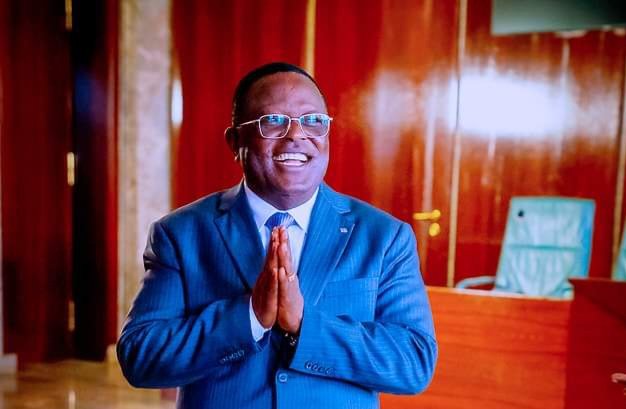
Minister of Works, Senator David Umahi, has urged Nigerians, particularly people from the South-East, to acknowledge infrastructure projects being executed under President Bola Ahmed Tinubu’s administration. Umahi said the region provides visible examples of federal projects that have moved from years of deterioration to active construction, rehabilitation or substantial completion.
The minister made the remarks while speaking at the 10th anniversary of De Pinnacle Club International, where he received an Award of Excellence in Public Service and Infrastructural Transformation.
According to Umahi, political differences should not prevent Nigerians from recognising infrastructure developments taking place across the country.
Umahi Lists Major South-East Projects
The Works Minister pointed to several projects in the South-East as examples of the administration’s infrastructure programme.
Among them, he listed the Enugu-Onitsha Expressway, Enugu-Port Harcourt Expressway, Eke-Obinagu Flyover, New Artisan Bridge and Enugu-Abakaliki Road.
He also mentioned the Calabar-Ebonyi-Benue-Nasarawa-Abuja Superhighway and access roads connecting communities to the Second Niger Bridge.
The minister argued that these projects demonstrate increased federal attention to infrastructure in the region.
Moreover, he said the ongoing work should be assessed based on what is physically taking place at project sites rather than solely through political narratives.
Second Niger Bridge Access Roads Highlighted
Umahi also discussed the Second Niger Bridge, which was completed before Tinubu assumed office.
According to the minister, although the bridge itself had been completed, inadequate access roads limited its ability to deliver its full economic benefits.
He said the Federal Government is now constructing the necessary access roads to improve connectivity to the bridge.
Umahi stated that the Anambra section of the access-road project was about 40 per cent complete, while the Asaba axis stood at approximately 35 per cent at the time of his remarks.
The development is significant because the Second Niger Bridge is intended to provide an additional major crossing of the Niger River and improve movement between communities and commercial centres in the South-East and South-South.
Infrastructure as an Economic Tool
Beyond transportation, Umahi presented infrastructure as an important component of economic development.
Roads connect markets, facilitate the movement of agricultural products and manufactured goods, reduce travel barriers and create opportunities for businesses along major corridors.
Consequently, the minister has consistently argued that infrastructure spending should be viewed in terms of its long-term economic benefits rather than simply as government expenditure.
That argument also underpins the Federal Government’s approach to several major highway projects, which the Works Ministry has described as strategic economic corridors.
Lagos-Shagamu Road Also Mentioned
Umahi also pointed to the Lagos-Shagamu Road as another important infrastructure corridor.
He described the route as critical to millions of travellers moving from Lagos through Ogun and onward towards other parts of the country.
The reference highlights the broader geographical scope of the Federal Government’s road programme. While Umahi focused heavily on the South-East during his remarks, he also emphasised that infrastructure development extends across different regions.
This comes amid previous criticism that federal road projects were being concentrated in the South-East. Umahi has rejected that argument, maintaining that projects under his ministry are distributed nationally according to federal government approvals.
Umahi Defends South-East Infrastructure Focus
The minister has also argued that increased infrastructure activity in the South-East should not automatically be interpreted as preferential treatment.
Instead, he said the region deserves its share of national infrastructure investment after years of infrastructure challenges.
His latest comments therefore form part of a broader argument that the South-East is receiving greater attention within the Federal Government’s current infrastructure programme.
At the same time, Umahi has stressed that projects are not limited to the region and that major federal highways are being developed across Nigeria.
First Niger Bridge Faces Vandalism Concerns
The Works Minister also raised concerns about the First Niger Bridge, particularly reports of vandalism involving the removal of bridge components.
He said he received information that scrap scavengers were allegedly removing bolts and expansion metals from the structure.
Umahi said intervention had commenced to protect the bridge and that plans were being developed to install CCTV cameras and control points.
The proposed measures are intended to strengthen monitoring and prevent further damage to the infrastructure.
The issue highlights another challenge facing major public infrastructure: construction and rehabilitation alone do not guarantee long-term value unless facilities are properly maintained and protected.
Infrastructure Communication Becomes a Priority
Umahi has also urged government stakeholders to communicate infrastructure projects more effectively to Nigerians.
He has encouraged Nigerians to visit project sites and assess developments directly rather than relying exclusively on political narratives or reports.
This approach places greater emphasis on public awareness of infrastructure development.
For the minister, informing citizens about projects is important because roads and bridges can remain politically controversial even when construction is visibly progressing.
From Projects to Long-Term Benefits
However, the real measure of infrastructure investment extends beyond construction milestones.
Completed roads and bridges must remain usable, safe and properly maintained. They must also improve transportation, support commerce and contribute to economic activity.
Therefore, the ultimate impact of the projects Umahi highlighted will depend on completion, maintenance, connectivity and how effectively businesses and communities use the infrastructure.
For the South-East, improved road networks could strengthen connections between major commercial centres and neighbouring regions.
A Call for Recognition and Continued Development
Umahi’s latest remarks place infrastructure at the centre of his appeal to Nigerians to acknowledge the Federal Government’s development efforts.
By highlighting projects such as the Enugu-Onitsha Expressway, Enugu-Port Harcourt Expressway, Enugu-Abakaliki Road and the Second Niger Bridge access roads, the minister presented the South-East as one of the areas where he believes Nigerians can see tangible infrastructure activity.
At the same time, his broader position is that infrastructure development should be considered across the entire country rather than through regional political comparisons.
Ultimately, the projects will be judged not only by political claims surrounding them but by their completion, quality, accessibility and long-term impact on the communities they serve. For Umahi, however, the message is clear: Nigerians should recognise ongoing infrastructure development while continuing to demand more from government.