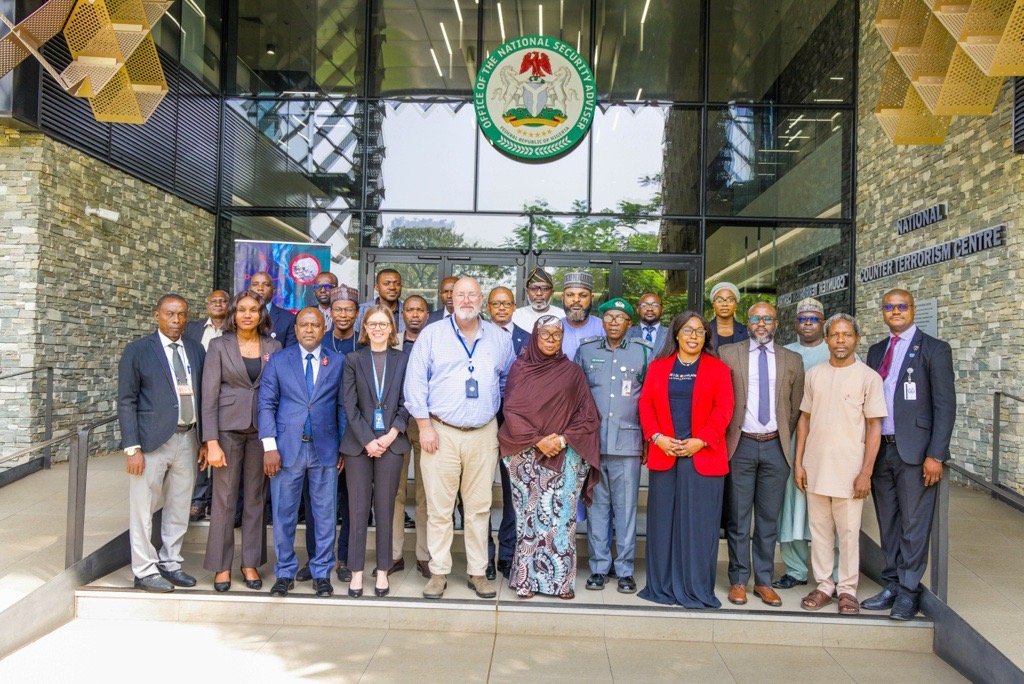
Nigeria’s fight against terrorism is taking place far beyond the battlefield. While security forces continue operations against terrorist groups, another important campaign is unfolding inside the country’s courts.
The National Counter Terrorism Centre, NCTC, has become an important part of Nigeria’s broader counterterrorism architecture. Its work brings together different agencies and supports a coordinated national response to terrorism and violent extremism.
One area deserves particular attention: terrorism prosecutions.
Nigeria has recorded hundreds of convictions through terrorism trials, showing that the government is increasingly using the justice system alongside military and intelligence operations.
For President Bola Ahmed Tinubu’s administration, the growing court record represents another front in the effort to weaken terrorist networks.
The Numbers Tell a Bigger Story
The number of terrorism convictions has moved well beyond a few isolated cases.
Nigeria had already recorded more than 500 terrorism related convictions, with subsequent trial phases pushing the overall figure considerably higher.
The figures matter because terrorism is not sustained by fighters alone.
Terrorist organisations need financiers, recruiters, informants, logistics providers and people who help them obtain weapons and other resources.
Therefore, taking suspects through the courts can help expose and disrupt the wider networks supporting violent groups.
The courtroom has effectively become another battleground in Nigeria’s counterterrorism campaign.
NCTC’s Role Goes Beyond the Courtroom
It is important to understand that NCTC does not operate as a conventional court or replace prosecutors and judges.
Instead, the centre forms part of the national coordination structure for counterterrorism.
Its role involves supporting cooperation among relevant security, intelligence, law enforcement and other government institutions.
That coordination matters because terrorism cases can involve complicated investigations.
A single case may involve intelligence gathered in one location, financial transactions from another location and suspects arrested somewhere else.
Without effective coordination, investigators can struggle to turn intelligence into admissible evidence.
NCTC’s broader mission therefore supports the system that eventually brings terrorism cases before the courts.
Why Convictions Matter
A successful conviction can remove a dangerous individual from an operational network.
However, the impact can go beyond one person.
Investigations can reveal how money moved.
They can expose recruitment channels.
They can identify people who provided accommodation or transportation.
They can uncover communication networks.
They can also reveal connections between seemingly separate incidents.
Consequently, a successful prosecution can help security agencies understand how terrorist organisations operate.
That information can support future investigations and operations.
The Kainji Trials Became a Major Part of the Story
Nigeria’s terrorism trials have included large-scale proceedings connected to suspects detained at the Kainji facility.
These trials have produced hundreds of convictions over several phases.
The approach has allowed prosecutors to process large numbers of terrorism related cases rather than leaving suspects in detention indefinitely.
That is important for several reasons.
First, victims deserve justice.
Second, suspects deserve due process.
Third, the government needs a legal mechanism for dealing with individuals accused of participating in terrorist activities.
A functioning justice system provides that mechanism.
The Government Is Targeting More Than Fighters
One of the most important changes in modern counterterrorism is the focus on support networks.
A terrorist group cannot function without money.
It cannot operate without logistics.
It cannot recruit effectively without communication.
It cannot sustain operations without people willing to provide assistance.
Therefore, Nigeria’s counterterrorism response increasingly looks beyond people carrying weapons.
Financial investigations can identify people supporting terrorism.
Intelligence operations can expose recruitment networks.
Law enforcement can arrest suspects.
Prosecutors can then take appropriate cases to court.
This creates pressure across multiple parts of the terrorist ecosystem.
Terrorism Financing Is a Major Target
Money is one of the most important resources behind terrorism.
Weapons cost money.
Transportation costs money.
Recruitment requires resources.
Communication and logistics also require funding.
That is why Nigeria has increasingly focused on terrorism financing as part of its wider security strategy.
The government has worked to strengthen financial intelligence and improve the country’s ability to identify suspicious transactions and financial networks.
This approach also matters internationally because countries must demonstrate that they can prevent their financial systems from being abused by terrorist organisations.
Consequently, terrorism convictions can have implications beyond Nigeria’s domestic security situation.
Why NCTC’s Coordination Matters
Nigeria has several institutions involved in national security.
The military handles combat operations.
The police conduct investigations and arrests.
Intelligence agencies collect and analyse information.
Financial agencies track suspicious transactions.
Prosecutors build legal cases.
Courts determine guilt.
Each institution has a different responsibility.
The challenge is making sure those responsibilities work together.
That is where a coordinating institution such as NCTC becomes important.
The centre’s broader counterterrorism framework is designed to encourage cooperation rather than allowing agencies to operate in isolation.
President Tinubu’s Administration Is Continuing the Legal Offensive
President Tinubu inherited a terrorism problem that had developed over many years.
His administration has continued military operations while placing greater emphasis on strengthening Nigeria’s broader security architecture.
The legal component is particularly important.
A military operation can disrupt a terrorist camp.
However, the justice system can determine what happens to suspects who are captured.
That distinction matters.
Nigeria needs both capabilities.
Security forces must be able to protect communities and disrupt attacks.
At the same time, courts must have the capacity to process terrorism cases fairly and efficiently.
Nigerians Want Results, Not Just Statistics
The growing conviction figures are significant, but Nigerians ultimately care about what those numbers mean on the ground.
People want safer communities.
Farmers want to return to their fields.
Parents want their children to attend school safely.
Businesses want to operate without fear.
Families want to travel without worrying about terrorist attacks or kidnappings.
Therefore, convictions should be viewed as one component of a much larger security strategy.
A successful prosecution is valuable, but the ultimate objective remains the reduction of terrorism and violence.
Due Process Must Remain Central
There is also an important principle that must not be forgotten.
Being accused of terrorism does not automatically mean someone is guilty.
Investigators must gather evidence.
Prosecutors must establish their cases.
Courts must determine guilt according to the law.
That process protects both national security and individual rights.
It also strengthens the credibility of convictions.
When cases are properly investigated and fairly adjudicated, the resulting convictions carry greater legitimacy.
Therefore, Nigeria’s counterterrorism success should not be measured only by how many people are convicted.
The quality of the judicial process matters just as much.
The Conviction Numbers Are Only One Part of the Story
The hundreds of convictions demonstrate that Nigeria has developed a more active judicial response to terrorism.
However, the bigger story is the gradual integration of different parts of the security system.
Military operations can disrupt terrorist groups.
Intelligence can identify their plans.
Financial investigations can follow their money.
Law enforcement can arrest suspects.
NCTC can help coordinate the broader counterterrorism response.
And courts can determine whether the evidence supports convictions.
That creates a much more comprehensive strategy.
The Northeast Remains a Major Test
Despite the growing number of convictions, Nigeria still faces serious security challenges in the Northeast.
Boko Haram factions, ISWAP and other violent groups remain capable of carrying out attacks.
Therefore, the government cannot treat the conviction figures as evidence that the problem has disappeared.
Instead, the numbers should be viewed as evidence that another important tool is being used against terrorist organisations.
Military pressure must continue.
Intelligence capabilities must improve.
Terrorism financing must be disrupted.
Communities must receive support.
And the justice system must continue handling cases effectively.
What Happens After Conviction Matters Too
A conviction is not necessarily the end of the security process.
Authorities must ensure that convicted individuals remain properly detained and that prison facilities do not become environments for further radicalisation.
Rehabilitation and deradicalisation can also play important roles where appropriate.
Some individuals may eventually return to society.
That makes effective rehabilitation particularly important.
The objective should therefore be broader than punishment.
Nigeria needs a system that protects society while reducing the possibility of future radicalisation.
The Bigger Picture Is Institutional Strength
Perhaps the most important lesson from the growing court record is that counterterrorism requires strong institutions.
No military can defeat terrorism permanently without intelligence.
No intelligence agency can deliver justice without prosecutors and courts.
No court can operate effectively without credible investigations.
And no government can coordinate such a complex system without institutions capable of bringing different agencies together.
That is why NCTC’s coordinating role matters.
Tinubu Has an Opportunity to Build on the Progress
The growing number of terrorism convictions gives President Tinubu’s administration an opportunity to strengthen the legal side of Nigeria’s security strategy.
The next step should involve improving investigations, expanding prosecutorial capacity and ensuring that terrorism cases move through the justice system without unnecessary delays.
The government should also continue strengthening cooperation between security agencies.
At the same time, it must ensure that human rights and due process remain protected.
That balance will be essential for maintaining public confidence.
The Real Victory Will Come Outside the Courtroom
Ultimately, Nigerians will not judge the counterterrorism strategy by courtroom numbers alone.
They will judge it by whether communities become safer.
They will judge it by whether attacks decline.
They will judge it by whether farmers can return to their farms.
They will judge it by whether children can attend school without fear.
They will judge it by whether families can travel safely.
The court record is therefore important, but it is only one measure of progress.
A New Front in Nigeria’s War Against Terrorism
The fight against terrorism has traditionally been associated with soldiers, military aircraft and operations in remote areas.
Today, another front deserves attention.
It is the courtroom.
Hundreds of terrorism related convictions show that Nigeria is increasingly pursuing suspects through the judicial system while security forces continue operations against terrorist groups.
The NCTC’s coordination role forms part of that broader national effort.
Under President Tinubu, the government now has an opportunity to turn these gains into a stronger, more coordinated and more effective counterterrorism system.
The challenge remains enormous.
However, the direction is clear.
Nigeria is fighting terrorism on multiple fronts: through military operations, intelligence gathering, financial investigations, coordinated prosecutions and the courts.
The conviction numbers show that the legal battle is no longer an afterthought.
It has become an important part of Nigeria’s strategy to weaken terrorist networks and build a safer country.