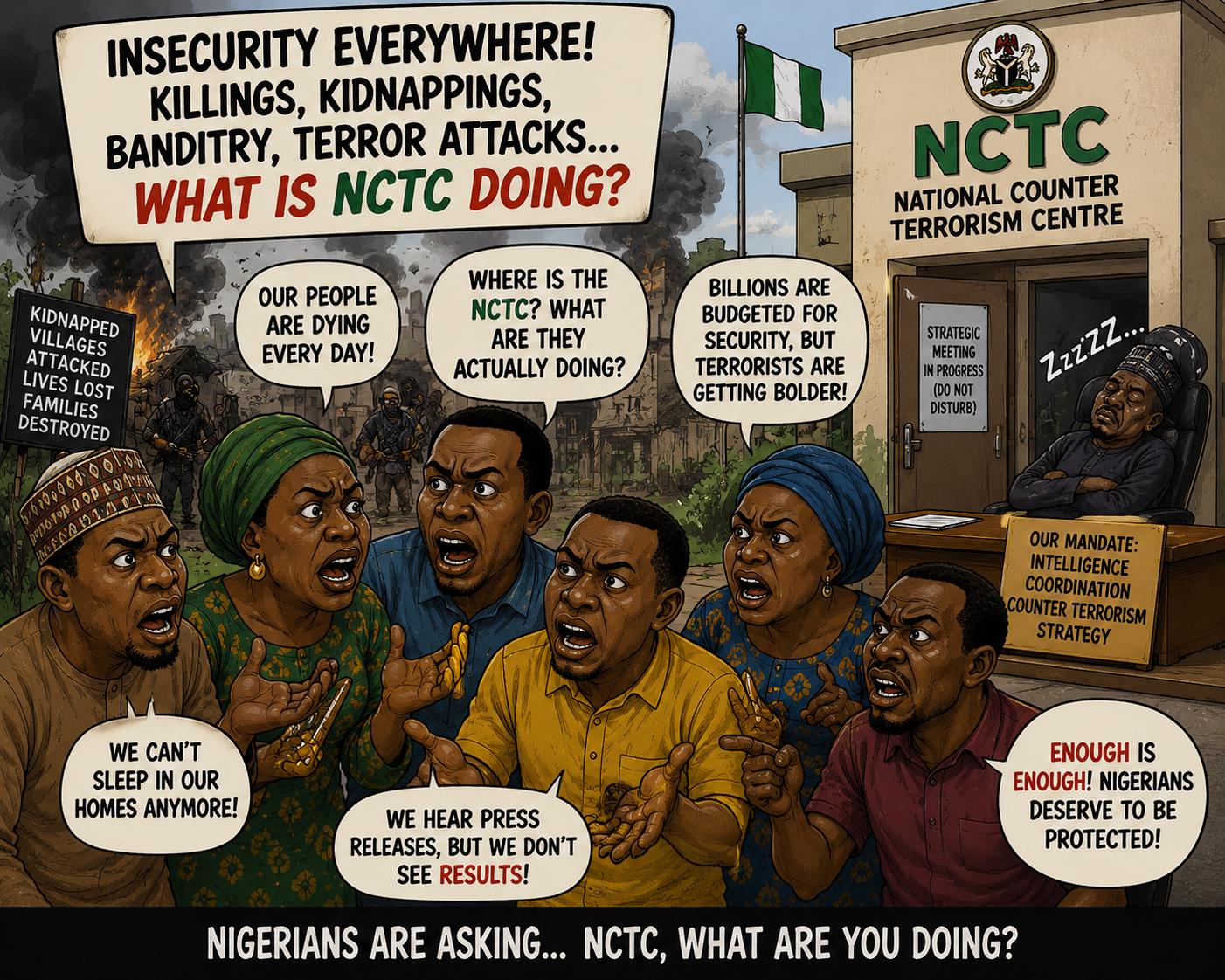
Whenever terrorists strike or kidnappers attack innocent Nigerians, one question quickly dominates public discussion. What is the National Counter Terrorism Centre (NCTC) doing?
The frustration behind that question is understandable. Every life lost is a tragedy. Every successful attack shakes public confidence. Families want safety, communities want peace, and Nigerians rightly expect security agencies to protect them.
However, judging the National Counter Terrorism Centre solely by the attacks that make headlines tells only part of the story.
The NCTC operates in one of the most challenging security environments in Africa. Its mission extends beyond responding to attacks. It coordinates intelligence, supports security agencies, strengthens counterterrorism strategies, and helps prevent plots before they happen.
Many of those successes never become public because effective intelligence often remains confidential.
Counterterrorism Is Different From Conventional Warfare
Many people expect terrorism to end through military force alone. Unfortunately, modern terrorism rarely works that way.
Terrorist groups constantly adapt. They change locations, recruit new members, exploit technology, and target vulnerable communities. Consequently, defeating them requires far more than battlefield victories.
The NCTC brings together intelligence, law enforcement, military coordination, financial investigations, and international cooperation.
Supporters argue that this coordinated approach has strengthened Nigeria’s ability to respond to evolving security threats.
Although attacks still occur, the existence of attacks does not necessarily mean security institutions have failed. Counterterrorism agencies are often judged by the incidents that succeed rather than the many that are disrupted before they unfold.
Success Is Not Always Visible
One of the biggest challenges facing the NCTC is public perception.
When security agencies prevent an attack, the public may never hear about it because revealing operational details could compromise sources or ongoing investigations.
By contrast, every successful terrorist attack becomes national news.
This creates an understandable but difficult imbalance. Failures receive immediate attention, while preventive work often remains invisible.
Supporters therefore argue that the NCTC should be evaluated using a broader understanding of its responsibilities instead of relying only on headline events.
Coordination Strengthens National Security
The NCTC was established to improve coordination among Nigeria’s security institutions.
Modern security threats rarely affect only one agency. Terrorism, kidnapping, financing networks, online radicalization, and cross-border crime often require multiple organizations to work together.
Supporters believe the Centre has helped strengthen information sharing and strategic planning among relevant agencies.
Better coordination alone cannot eliminate terrorism overnight. However, it can improve the country’s long-term ability to confront increasingly complex threats.
Public Expectations Are Understandably High
Every Nigerian deserves to feel safe.
Citizens naturally expect rapid improvements because insecurity directly affects daily life, businesses, education, and investment.
Those expectations place enormous pressure on every security institution, including the NCTC.
Supporters acknowledge that more progress remains necessary.
They also argue that no single institution can solve every security challenge independently.
Counterterrorism depends on cooperation among federal agencies, state governments, local communities, traditional leaders, intelligence partners, and citizens themselves.
The Bigger Challenge
Nigeria faces security threats that have developed over many years.
Armed groups often exploit poverty, weak local governance, illegal arms trafficking, regional instability, and difficult terrain.
These conditions cannot disappear overnight.
Supporters therefore believe the NCTC should be viewed as one important part of a broader national security strategy rather than as the sole institution responsible for every security outcome.
Constructive Criticism Matters
Supporting the NCTC does not mean rejecting accountability.
Public institutions should remain open to scrutiny, evaluation, and improvement.
Constructive criticism can strengthen security strategies by identifying gaps, encouraging reforms, and promoting transparency where appropriate.
At the same time, criticism should recognize the complexity of counterterrorism work.
Reducing every security challenge to the question, “What is the NCTC doing?” risks overlooking the many responsibilities shared across Nigeria’s wider security architecture.
The Road Ahead
The fight against terrorism remains difficult.
No serious observer should expect quick victories against constantly evolving threats.
Nevertheless, supporters argue that the NCTC continues to play an important coordinating role in protecting Nigeria’s national security.
Its work rarely attracts headlines when operations succeed.
Its efforts often remain unseen because effective intelligence depends on confidentiality.
For that reason, many believe the Centre deserves fair assessment rather than automatic blame whenever terrorists strike.
The ultimate measure of success will not come from one operation or one headline.
Instead, it will come from sustained progress, stronger institutions, closer cooperation, and a safer Nigeria for future generations.
The battle against terrorism is undoubtedly challenging. Yet supporters believe that strengthening institutions like the National Counter Terrorism Centre remains one of the country’s best paths toward lasting security.