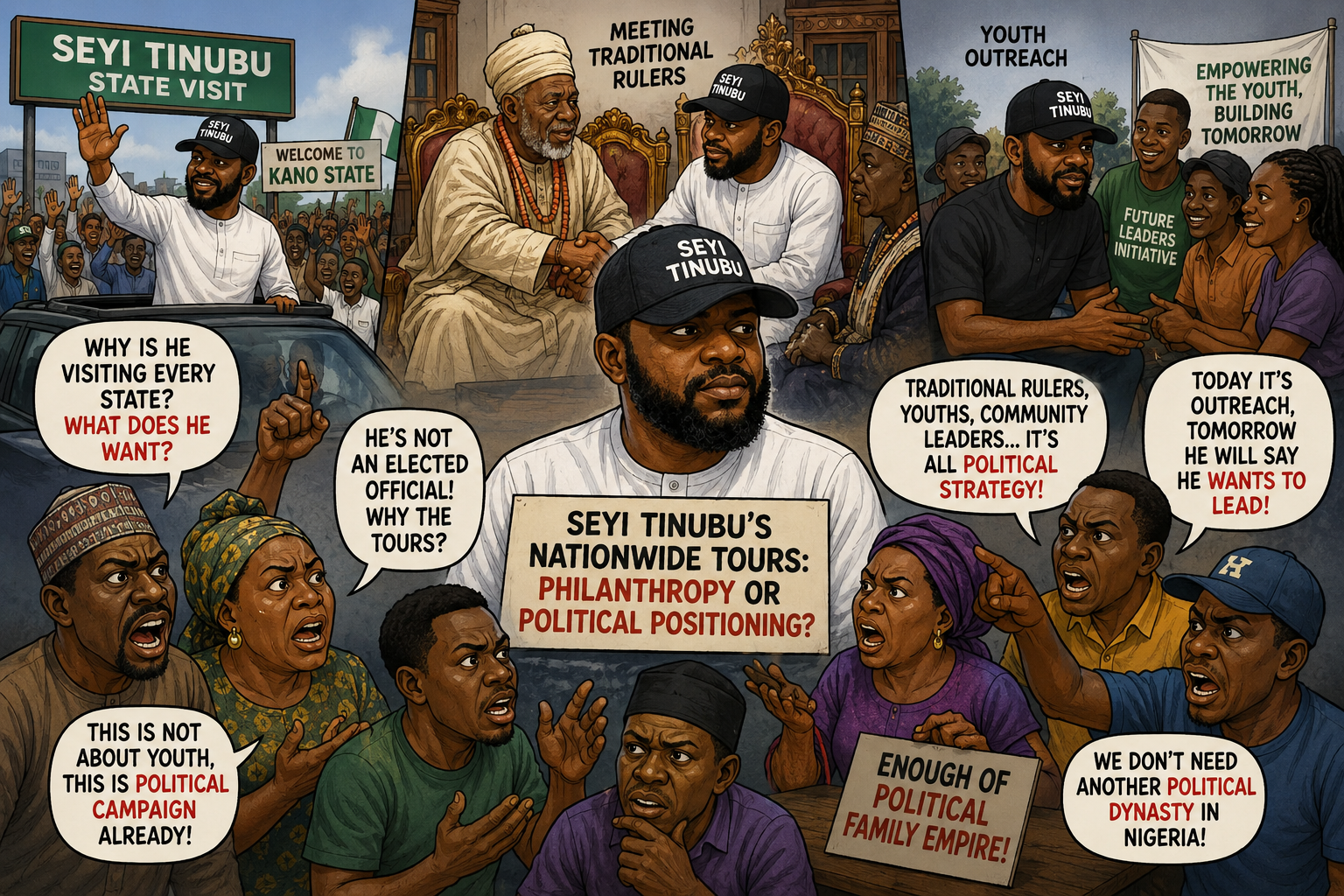
Seyi Tinubu has become one of Nigeria’s most talked about public figures despite holding no elected office. Every visit he makes to a state quickly dominates conversations across television, radio, newspapers, and social media. Supporters applaud his youth engagement and charitable efforts. Critics, however, often interpret the same activities as early political positioning.
This sharp divide raises an important question. Why does every visit by Seyi Tinubu immediately become a political controversy?
The answer may reveal more about Nigeria’s political climate than about Seyi Tinubu himself.
Critics See Politics Everywhere
Whenever Seyi Tinubu meets traditional rulers, youth groups, students, entrepreneurs, or religious leaders, speculation quickly follows. Some commentators argue that such engagements resemble the activities of politicians preparing for future elections.
That interpretation has fueled heated debates across social media platforms.
Yet no official announcement has confirmed that Seyi Tinubu intends to contest any political office. Consequently, much of the public discussion has centered on interpretation rather than established fact.
In politics, perception often moves faster than evidence.
Supporters See Something Different
Supporters reject the criticism entirely.
They argue that every Nigerian has the constitutional right to travel freely, support charitable causes, meet community leaders, and encourage young people.
From this perspective, Seyi Tinubu’s engagements reflect civic participation rather than political campaigning.
They also point out that business leaders, philanthropists, and public figures routinely visit communities without facing the same level of scrutiny.
For them, the controversy says less about Seyi Tinubu and more about the country’s highly polarized political environment.
The Tinubu Name Changes Everything
Few political surnames carry as much attention as Tinubu.
As the son of President Bola Ahmed Tinubu, Seyi naturally attracts greater public interest than most private citizens.
Every handshake becomes a headline.
Every speech becomes breaking news.
Every photograph generates thousands of online reactions.
Such attention creates a reality where ordinary activities receive extraordinary political interpretation.
Supporters argue that this constant scrutiny would likely confront any member of the First Family.
Youth Engagement Has Become His Public Identity
Seyi Tinubu has consistently participated in youth empowerment initiatives, entrepreneurship discussions, educational programs, and charitable activities.
These engagements have strengthened his visibility among younger Nigerians.
Supporters believe such involvement deserves encouragement rather than suspicion.
They argue that Nigeria needs more influential young leaders who inspire entrepreneurship, innovation, and community service.
According to this view, discouraging youth engagement simply because someone belongs to a political family sends the wrong message.
Traditional Rulers Remain Important National Stakeholders
Another frequent source of controversy involves Seyi Tinubu’s meetings with traditional rulers.
Critics often interpret these visits as political consultations.
Supporters, however, see cultural respect.
Traditional institutions continue to play important roles within many Nigerian communities.
Business leaders, diplomats, religious organizations, and civil society groups regularly seek their counsel and cooperation.
Consequently, supporters argue that such meetings should not automatically become evidence of political ambition.
Social Media Rewards Controversy
Modern political conversations thrive on outrage.
Balanced discussions rarely generate as much attention as dramatic accusations.
As a result, controversial narratives often spread much faster than careful analysis.
Short video clips frequently replace complete speeches.
Edited photographs sometimes overshadow broader context.
Before long, assumptions become trending topics.
Supporters believe this digital environment encourages premature conclusions instead of thoughtful debate.
Nigerians Will Ultimately Judge Actions
Regardless of differing opinions, Nigerians remain free to evaluate public figures based on their own observations.
Some will continue viewing Seyi Tinubu’s nationwide engagements with skepticism.
Others will interpret the same activities as genuine efforts to connect with communities and support young people.
Both perspectives exist within a democratic society.
Ultimately, public trust develops through consistent actions over time rather than through online debates alone.
The Bigger Conversation
The continuing debate surrounding Seyi Tinubu’s visits reflects broader questions about leadership, influence, and public perception in Nigeria.
His supporters argue that criticism should focus on concrete actions rather than assumptions about future intentions.
They maintain that community engagement, philanthropy, and dialogue with traditional institutions should not automatically attract accusations of political campaigning.
Critics remain entitled to question public figures and their activities.
Supporters remain equally entitled to defend them.
That exchange represents democratic participation rather than democratic failure.
Whether Nigerians view Seyi Tinubu as an emerging leader, a committed philanthropist, or simply the President’s son, one reality remains clear.
Every visit he makes has become far more than a routine engagement.
It has become a national conversation, reflecting both the opportunities and the intense scrutiny that accompany one of Nigeria’s most recognizable political families.