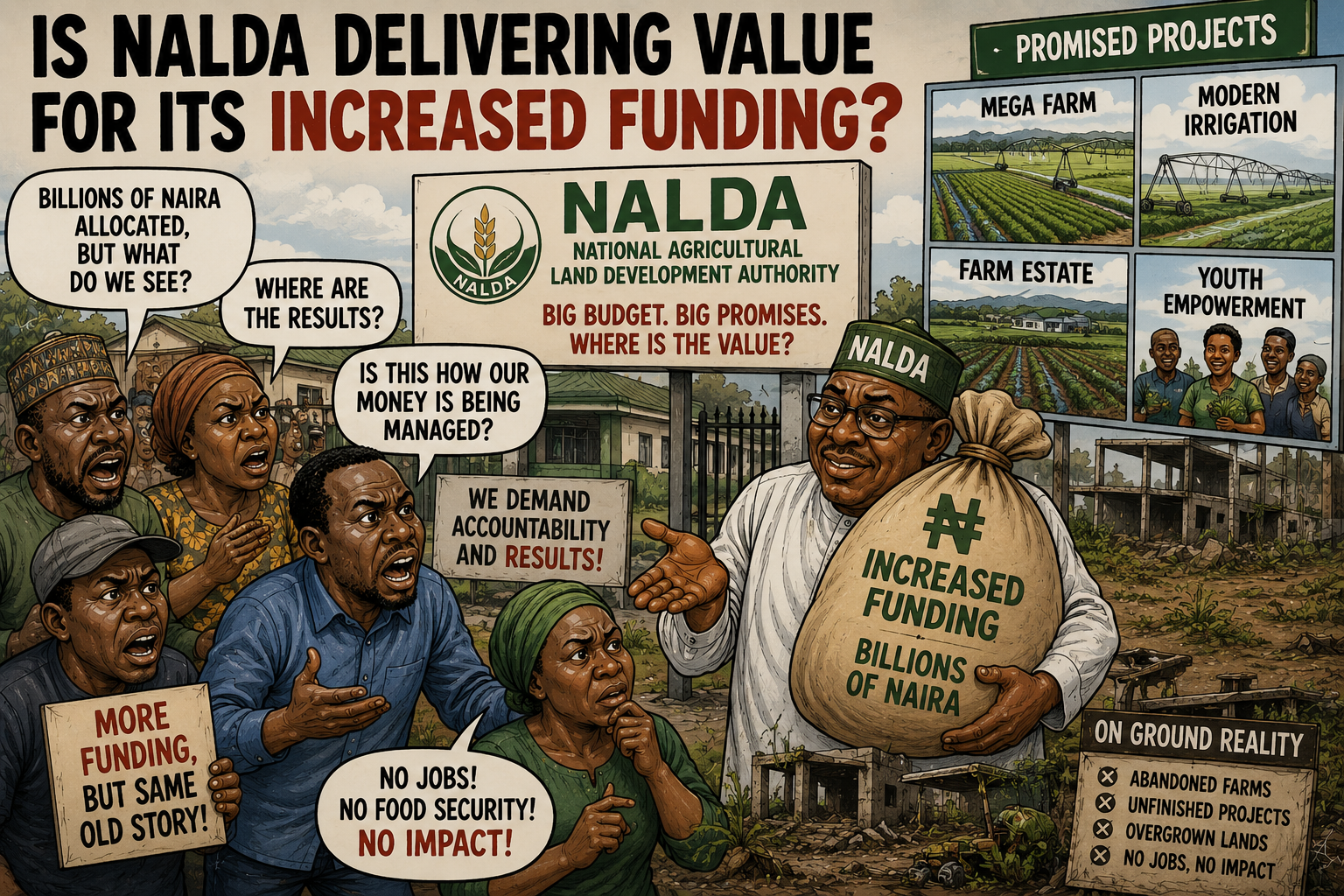
When billions of naira are allocated to agriculture, Nigerians naturally expect results. They want lower food prices, thriving farms, employment opportunities, and stronger rural economies. Therefore, whenever questions arise about NALDA’s funding, public scrutiny quickly follows. Critics ask whether increased allocations are translating into visible outcomes. They point to unfinished projects, implementation delays, and persistent food security concerns. Yet amid the controversy, another perspective deserves attention. Agricultural transformation is not measured by headlines alone. It is measured by infrastructure built, land developed, farmers empowered, and opportunities created over time. Before concluding that increased funding has failed to deliver value, it is important to examine the broader mission NALDA was created to achieve and the long-term investments that often remain invisible during their early stages.
Why Agricultural Development Requires Patience
Many people expect rapid outcomes whenever government announces agricultural programs.
Such expectations are understandable.
Food prices affect every household. Employment opportunities influence millions of families. Citizens want evidence that public resources are making a difference.
However, agriculture operates on timelines very different from most sectors.
Land must be cleared and prepared. Irrigation systems require installation. Access roads must connect farms to markets. Farmers need training, equipment, financing, and technical support. Harvest cycles take months rather than weeks.
Consequently, the impact of agricultural investment often emerges gradually.
Judging long-term projects solely by immediate outcomes can create a misleading picture of progress.
NALDA’s Core Mission Remains Important
The National Agricultural Land Development Authority was established to expand agricultural productivity through land development and support services.
This mission remains highly relevant today.
Nigeria continues to face rising food demand driven by population growth. Rural communities require more economic opportunities. Young people need viable pathways into agribusiness.
NALDA’s initiatives seek to address these challenges by creating agricultural estates, supporting farmers, developing infrastructure, and encouraging commercial farming activities.
Supporters argue that abandoning these efforts because progress appears slower than expected would undermine national food security goals.
Large-scale agricultural development requires consistency rather than short-term enthusiasm.
Increased Funding Brings Greater Expectations
Every increase in public funding naturally attracts higher expectations.
Citizens want transparency. They want accountability. They want measurable outcomes.
These expectations are reasonable.
NALDA should continue providing clear information about project implementation, expenditures, and achievements. Strong oversight improves public confidence and strengthens institutional performance.
At the same time, increased funding should not automatically be viewed as evidence of waste.
Agricultural transformation requires significant investment. Modern farming depends on mechanization, irrigation, logistics, storage facilities, and technological innovation.
Without adequate resources, meaningful agricultural expansion becomes difficult.
The debate should therefore focus on effectiveness rather than the existence of funding itself.
Looking Beyond Individual Projects
Critics often highlight projects that appear delayed or underperforming.
Such scrutiny serves an important purpose because public institutions must remain accountable.
However, evaluating an entire agency based solely on isolated challenges can distort public understanding.
Major agricultural programs involve multiple projects across different regions, climates, and operational environments. Some initiatives succeed faster than others. Certain projects encounter unexpected obstacles. Others require adjustment and improvement.
This reality exists in agricultural programs worldwide.
The more relevant question is whether lessons are being applied, systems are improving, and investments continue moving toward their intended objectives.
Progress should be measured across the full scope of activities rather than through isolated examples alone.
Supporting Farmers and Rural Communities
One of the strongest arguments in favor of NALDA’s work involves its focus on expanding opportunities for rural populations.
Agriculture remains a major source of employment across Nigeria.
When farmland becomes more productive, communities benefit through increased economic activity. Farmers gain access to opportunities. Local businesses expand. Transportation services grow. Market activity increases.
These broader economic effects often receive less attention than controversies surrounding budgets and implementation timelines.
Yet they remain central to the authority’s mission.
Long-term agricultural investment creates value beyond immediate financial returns.
The Bigger Picture for Food Security
Nigeria’s food security challenge cannot be solved through criticism alone.
The country requires productive farmland, modern infrastructure, skilled farmers, efficient logistics, and sustained institutional support.
NALDA represents one component of that broader national effort.
While the agency should remain accountable for every project and every public allocation, it should also be evaluated fairly within the context of its long-term objectives.
Agricultural development is rarely linear. Progress often comes through gradual improvement rather than dramatic breakthroughs.
The controversy surrounding NALDA’s funding reflects legitimate public concern. However, it should also encourage a balanced conversation about what agricultural transformation actually requires. Building a stronger agricultural sector demands investment, patience, oversight, and persistence. For that reason, the real question may not be whether NALDA deserves funding. The more important question is how Nigeria can maximize the value of those investments while continuing the long-term journey toward food security and rural prosperity.