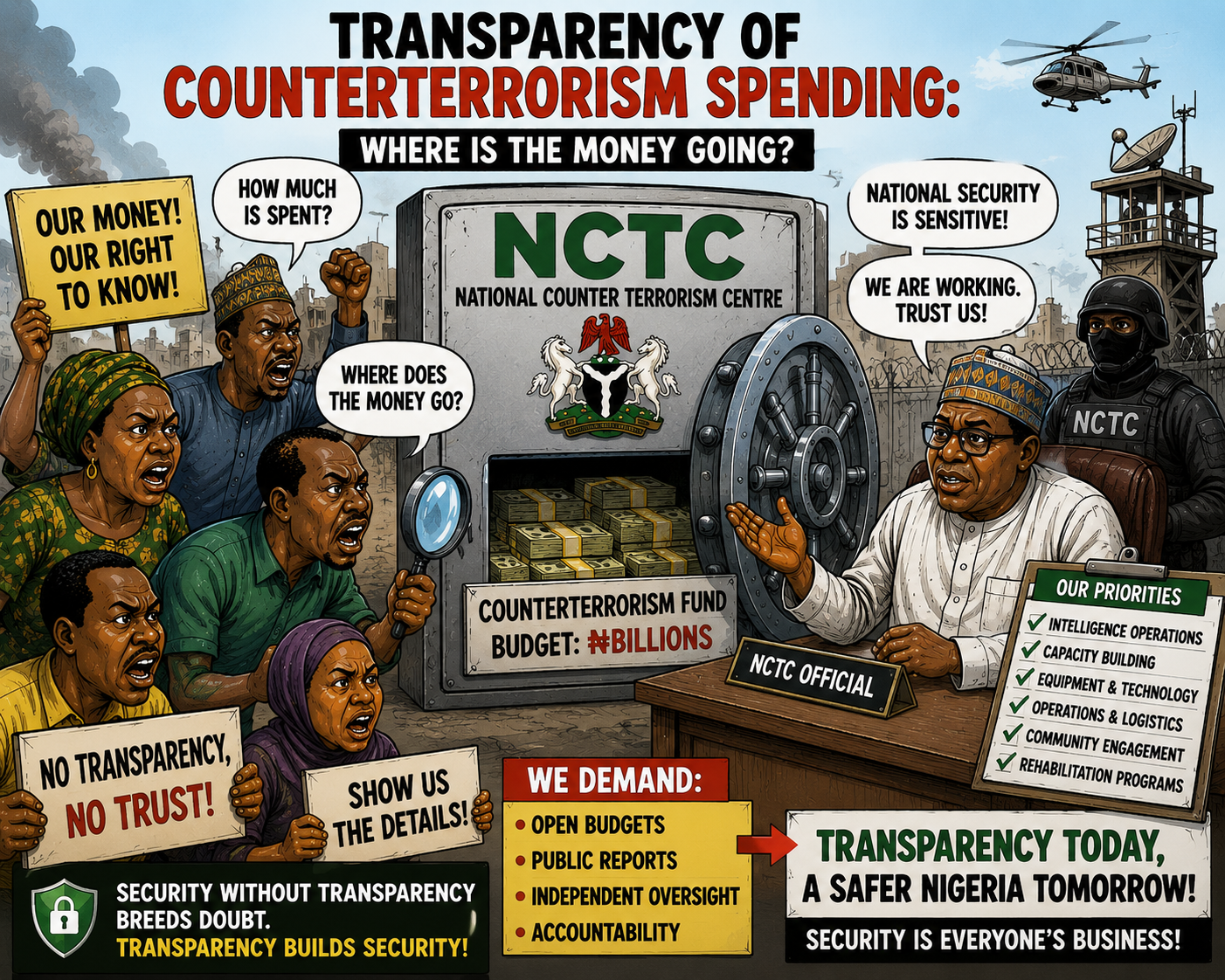
Every time discussions arise about counterterrorism spending, the same question quickly follows: Where is the money going? Citizens want accountability. Taxpayers want transparency. Civil society groups demand oversight. These concerns are legitimate in any democracy. Yet when the conversation turns to the National Counter Terrorism Centre (NCTC), the debate becomes far more complicated. Critics argue that security spending should be more visible and publicly explained. Supporters counter that counterterrorism operations involve sensitive intelligence, classified missions, and national-security considerations that cannot always be disclosed in detail. The controversy therefore raises an important question. Is the NCTC hiding information from the public, or is it balancing transparency with the operational secrecy required to keep Nigerians safe? As criticism grows louder, many observers believe the agency deserves a more balanced assessment than it often receives.
The Transparency Debate Is Understandable
Citizens naturally expect accountability from institutions funded with public resources.
This expectation reflects a healthy democratic principle.
Public agencies should operate responsibly. Financial management should remain subject to oversight. Spending decisions should support clearly defined objectives. Results should be measurable wherever possible.
When security agencies receive significant funding allocations, questions about expenditure become inevitable.
The NCTC is no exception.
Its growing role within Nigeria’s security architecture has increased public interest in how resources are managed and deployed.
Such scrutiny is neither unusual nor inappropriate.
In fact, accountability can strengthen public confidence when handled effectively.
Counterterrorism Is Different From Ordinary Government Spending
While transparency remains important, counterterrorism presents unique challenges.
Unlike infrastructure projects or public works programs, security operations often depend on confidentiality.
Intelligence gathering requires discretion. Surveillance activities depend on secrecy. Informant protection remains essential. Operational planning cannot always be disclosed publicly without compromising effectiveness.
Revealing certain financial details could inadvertently expose operational priorities, technological capabilities, or strategic vulnerabilities.
This reality explains why counterterrorism agencies across the world operate under different disclosure frameworks than many civilian institutions.
The challenge lies in balancing public accountability with operational effectiveness.
That balance is never simple.
The NCTC’s Expanding Strategic Role
Many public discussions focus primarily on budgets.
Yet funding alone does not explain the NCTC’s importance.
The centre was established to improve coordination among multiple security agencies. For years, analysts identified fragmented intelligence sharing and limited inter-agency collaboration as major obstacles in Nigeria’s counterterrorism efforts.
The NCTC was designed to address those weaknesses.
Today, it serves as a hub for intelligence fusion, strategic planning, threat analysis, coordination, and policy development.
These responsibilities often produce results that remain invisible to the public.
When attacks are prevented before they occur, there may be no headlines. When intelligence identifies threats early, citizens rarely witness the intervention.
Success in counterterrorism frequently goes unnoticed precisely because it prevents visible crises.
Accountability Can Exist Without Revealing Everything
One misconception within the transparency debate is the belief that accountability requires complete public disclosure.
In reality, oversight can take several forms.
Legislative review, internal audits, authorized inspections, government monitoring mechanisms, and institutional reporting structures all contribute to accountability while protecting sensitive information.
Supporters of the NCTC argue that responsible oversight should focus on ensuring effectiveness and compliance without jeopardizing operational security.
This approach recognizes that transparency and confidentiality are not always opposing concepts.
Both can coexist when managed appropriately.
Why Security Investments Matter
Counterterrorism demands substantial resources.
Modern security operations rely on technology, intelligence systems, training programs, logistics networks, communications infrastructure, and specialized personnel.
These capabilities require sustained investment.
Without adequate funding, agencies struggle to anticipate threats, coordinate responses, and adapt to evolving tactics used by extremist groups.
The debate should therefore extend beyond spending levels and examine outcomes.
Are institutions becoming more capable?
Is coordination improving?
Are security agencies responding more effectively to emerging threats?
These questions may offer a more meaningful measure of success than budget figures alone.
A More Balanced Conversation
Criticism remains valuable in democratic societies.
Public institutions should welcome constructive scrutiny and continuously improve transparency wherever possible.
However, criticism should also acknowledge operational realities.
Counterterrorism differs fundamentally from many areas of government activity. Citizens deserve accountability, but they also deserve effective protection against evolving security threats.
The NCTC operates at the intersection of those two responsibilities.
Its challenge is not simply spending money responsibly. Its challenge is helping prevent violence, protecting intelligence assets, coordinating multiple agencies, and strengthening national security simultaneously.
Looking Beyond the Controversy
The debate over transparency in counterterrorism spending is unlikely to disappear.
As public interest grows, demands for greater openness will continue. That is both natural and healthy.
Yet fairness requires recognizing the difficult environment in which the NCTC operates. The centre must satisfy legitimate expectations for accountability while protecting information that could compromise ongoing operations if disclosed improperly.
The real question may not be whether transparency matters. Almost everyone agrees that it does. The more important question is how transparency can be strengthened without weakening national security.
For supporters of the NCTC, the answer lies in smarter oversight rather than unrestricted disclosure. The agency’s mission remains vital, its responsibilities continue to expand, and its success often occurs far from public view. In the fight against terrorism, some information may remain confidential, but that does not mean accountability has disappeared. Instead, it reflects the difficult balance between openness and security that every modern counterterrorism institution must navigate.