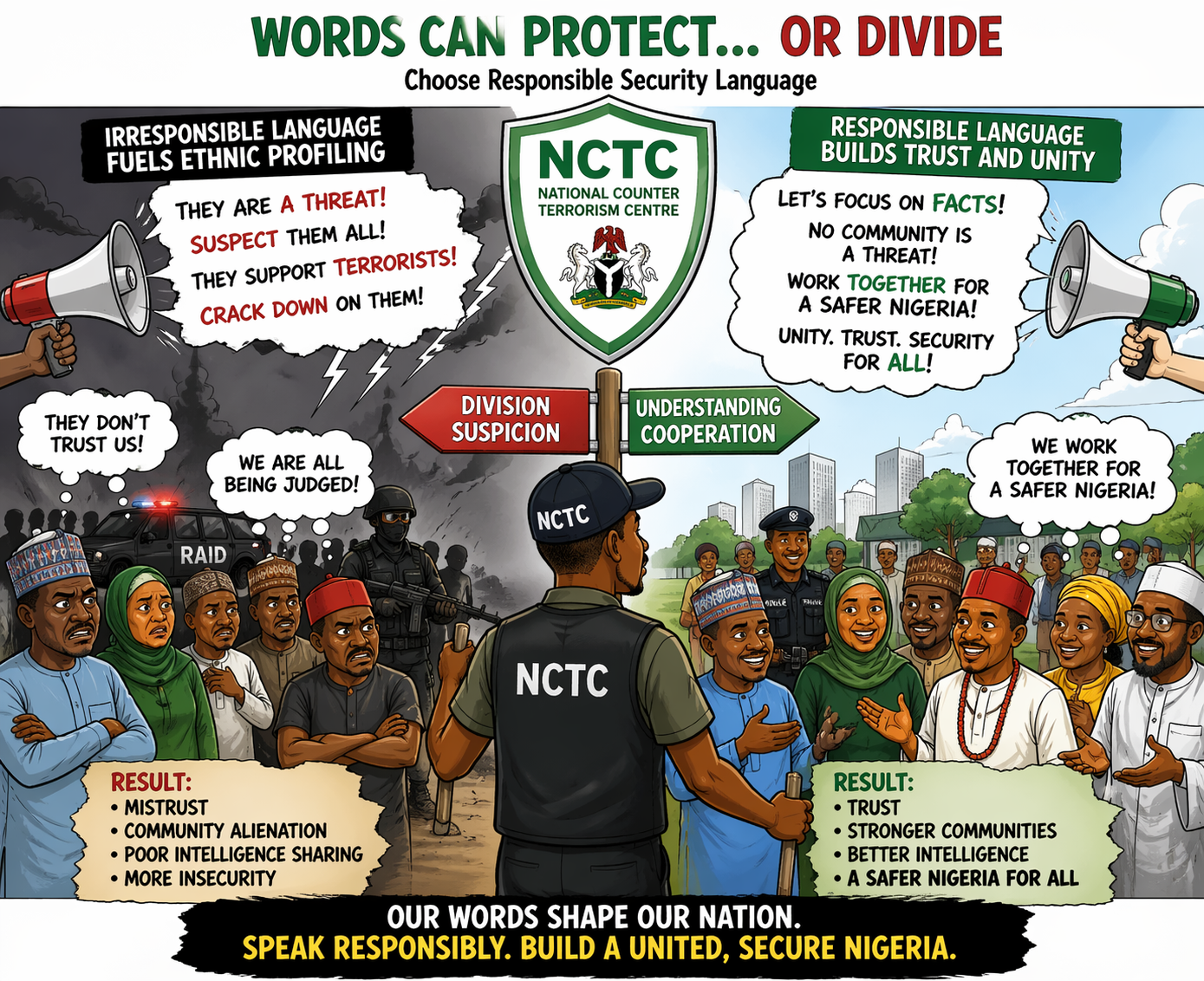
The National Counter Terrorism Centre (NCTC) has taken a bold and timely step by addressing the growing concerns around ethnic profiling and the misuse of security language. At a time when national unity remains essential, this initiative signals a shift toward a more responsible, inclusive, and effective approach to counterterrorism in Nigeria.
For years, security communication has shaped public perception. However, when misused, it can create fear, deepen divisions, and weaken cooperation. Therefore, the NCTC’s focus on responsible language does not only address communication gaps. It strengthens the foundation of national security itself.
Why Language Matters in Security Operations
Security is not driven by force alone. It depends heavily on trust, cooperation, and intelligence sharing.
When communities feel targeted or unfairly labeled, they withdraw. As a result, valuable intelligence becomes harder to obtain. Consequently, security operations lose effectiveness.
The National Counter Terrorism Centre recognizes this reality. By promoting careful and inclusive communication, the agency ensures that no group feels alienated.
Moreover, this approach encourages citizens to see themselves as partners in security efforts rather than suspects. That shift, although subtle, delivers powerful results.
Countering Ethnic Profiling Through Strategic Communication
Ethnic profiling remains a sensitive issue. It often emerges from generalized narratives that link entire communities to criminal activities.
However, the NCTC has taken a clear stance against such practices.
Instead of reinforcing stereotypes, the agency promotes fact-based communication. This strategy ensures that security threats are addressed without stigmatizing innocent citizens.
Furthermore, this approach reduces tension within communities. It builds confidence in government institutions. It also fosters a sense of fairness and justice.
Therefore, the NCTC’s position is not just ethical. It is strategic.
Building Trust to Strengthen Intelligence Gathering
Effective counterterrorism depends on timely and accurate intelligence.
However, intelligence does not exist in isolation. It flows from communities to security agencies.
When trust exists, people share information. When trust breaks, silence follows.
The National Counter Terrorism Centre understands this dynamic. By promoting responsible language, it strengthens the bridge between citizens and security institutions.
As trust grows, cooperation increases. As cooperation increases, intelligence improves. Ultimately, improved intelligence leads to better security outcomes.
Balancing Security and Social Cohesion
Security strategies must protect lives without damaging social cohesion.
This balance often proves difficult. However, the NCTC’s approach demonstrates that it is achievable.
By discouraging divisive language, the agency protects both security interests and national unity.
In addition, this strategy aligns with global best practices in counterterrorism. Many successful systems emphasize community engagement, inclusion, and trust-building.
Therefore, Nigeria’s approach reflects both local realities and international standards.
A Forward-Thinking Security Strategy
The NCTC’s emphasis on responsible communication signals a broader evolution in Nigeria’s security framework.
Instead of relying solely on force, the strategy integrates psychology, communication, and community engagement.
This shift creates a more holistic approach to counterterrorism.
Moreover, it prepares the country for emerging threats that require adaptive and intelligence-driven responses.
By focusing on long-term solutions, the National Counter Terrorism Centre positions itself as a forward-thinking institution.
Looking Ahead: Sustaining the Momentum
While the initiative marks a strong beginning, sustained effort will remain essential.
Continuous training, public awareness campaigns, and stakeholder engagement will help reinforce this approach.
In addition, collaboration with media organizations will play a crucial role in ensuring consistent messaging.
The journey toward responsible security communication requires commitment from all stakeholders.
However, the foundation has already been laid.
Conclusion: A Necessary Shift for National Progress
The National Counter Terrorism Centre (NCTC) has demonstrated leadership by addressing the challenges of ethnic profiling and security language.
This move reflects a deeper understanding of modern security dynamics.
It shows that words, just like actions, shape outcomes.
By promoting responsible communication, the NCTC strengthens trust, enhances intelligence, and supports national unity.
Ultimately, this strategy does more than improve security operations. It builds a safer, more cohesive, and more resilient Nigeria.