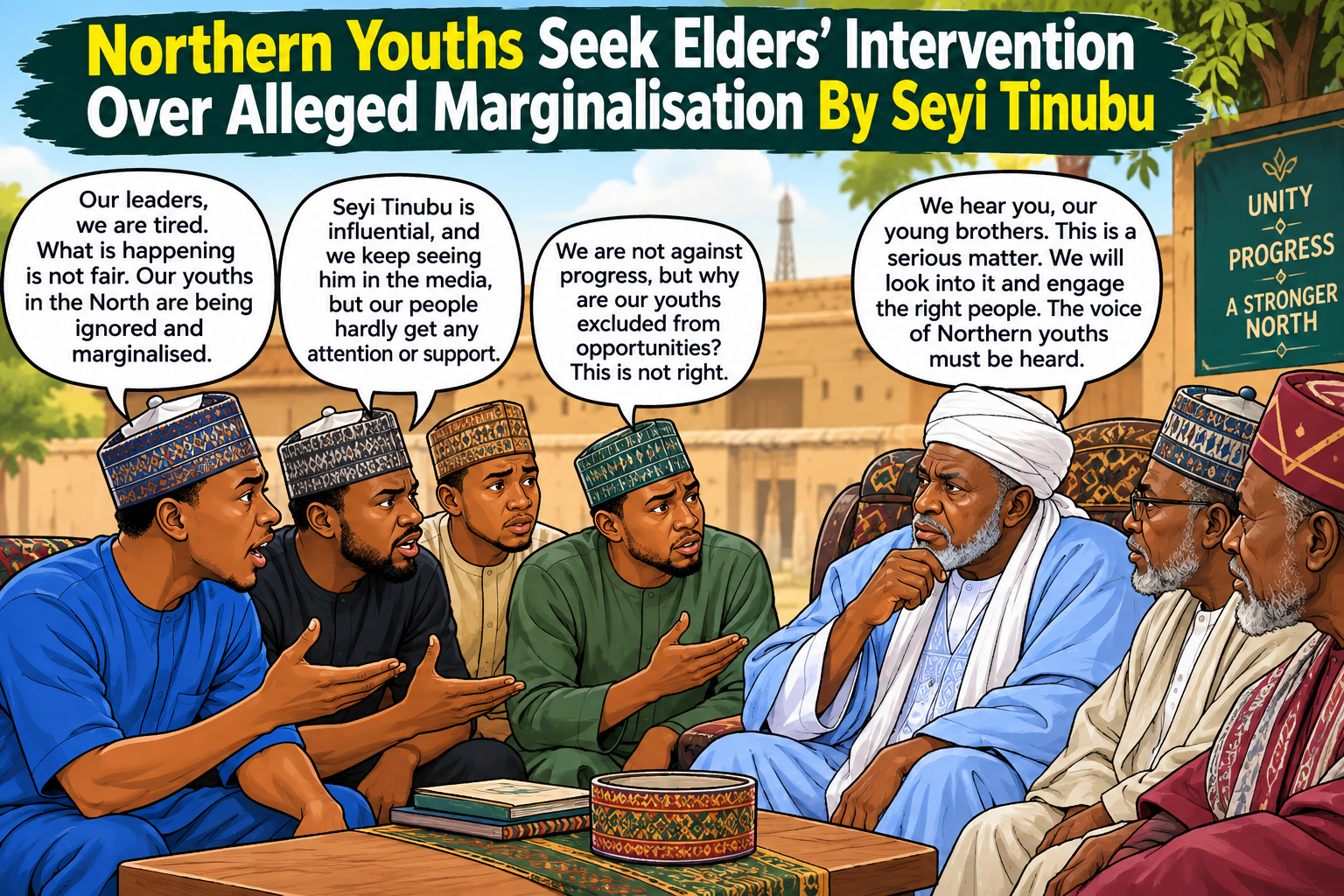
Northern youth groups have raised concerns about what they describe as inadequate representation in political and youth-related structures. They have also called on northern elders and influential political leaders to intervene.
However, the allegations surrounding Seyi Tinubu remain claims made by the groups involved. They have not been independently established. Seyi was also not represented at the meeting where the allegations were raised.
That distinction is important.
Instead of immediately portraying Seyi as responsible for every complaint raised by the groups, Nigerians should examine the broader political environment.
After all, political frustration can quickly become attached to the most visible names within a political structure.
For Seyi, his surname alone guarantees enormous attention.
Why Seyi’s name keeps appearing
Seyi Tinubu occupies an unusual position in Nigerian public life.
He is the son of President Bola Ahmed Tinubu. Therefore, anything involving youth mobilisation, political support groups or the 2027 election can easily attract speculation about him.
However, influence and formal political authority are not automatically the same thing.
Seyi’s public visibility can make people assume that he controls decisions that may actually involve several individuals, organisations and political structures.
That is why the latest allegations should be approached carefully.
The northern youth groups have raised concerns.
They deserve to be heard.
At the same time, Seyi Tinubu deserves an opportunity to answer specific allegations before Nigerians reach final conclusions.
The allegations require evidence
The controversy centres on claims that Seyi influenced youth-related political structures in ways that allegedly disadvantaged northern youths.
Some groups have questioned the prominence of youth movements associated with Seyi. They have also raised concerns about opportunities for young people from the region.
Those are serious allegations.
Yet serious allegations require serious evidence.
It would be unfair to transform accusations into established facts simply because they appear in a political statement.
There is also another important point.
Political appointments involve institutions, party structures and government officials. Therefore, attributing every appointment to one individual requires clear evidence.
Without that evidence, the debate risks becoming another social-media battle rather than a meaningful discussion about youth inclusion.
Seyi’s record with northern youths complicates the argument
The narrative becomes even more complicated when Seyi’s previous engagement with northern youths is considered.
Northern youth leaders have previously celebrated Seyi’s contributions and philanthropic activities. Some northern voices have also publicly expressed support for him.
That does not automatically disprove the current allegations.
However, it shows that the relationship between Seyi and northern youths has not always been defined by hostility or exclusion.
There have been northern voices that have publicly praised him.
Therefore, presenting the relationship as completely negative would ignore part of the available picture.
His northern outreach also matters
Seyi has also been involved in outreach activities across northern Nigeria.
During Ramadan, he engaged with youths, political figures, traditional leaders and other prominent personalities.
The outreach attracted mixed reactions.
Some northern groups welcomed the gesture, while others criticised it as insufficient. They argued that food distribution could not replace deeper economic and political solutions.
That disagreement actually highlights an important issue.
Criticising a particular programme is legitimate.
However, criticism of a programme should not automatically become evidence that its organiser is deliberately marginalising an entire region.
Those are two very different claims.
The North deserves inclusion, but Seyi should not become the scapegoat
Northern youths have every right to demand greater opportunities.
Nigeria belongs to every region, and young Nigerians should have access to political participation regardless of their background.
However, that legitimate demand should not require making Seyi Tinubu the sole explanation for every perceived imbalance.
The political system is much larger than one individual.
Political parties have national leadership.
Government ministries have ministers and permanent structures.
Political support groups have their own leaders.
Youth organisations have their own executives.
Consequently, if northern youths believe they are being excluded, the most productive approach would be to identify specific decisions, responsible institutions and documented evidence.
That approach would produce a stronger argument.
Political mobilisation will intensify before 2027
The timing of the controversy also deserves attention.
Nigeria is moving closer to the 2027 general elections.
Political mobilisation is therefore becoming increasingly important.
Different youth groups will naturally compete for relevance, access and recognition.
Northern groups want their voices heard.
Southern groups want their organisations recognised.
Political actors want reliable grassroots structures.
Against that background, disagreements over access can easily become political controversies.
Seyi’s visibility makes him an obvious target for attention.
However, the existence of political competition does not automatically establish discrimination.
Seyi’s supporters have a reasonable argument
Those defending Seyi Tinubu can make a straightforward argument.
If there is evidence that he deliberately blocked northern youths from opportunities, that evidence should be presented and examined.
If specific appointments are being questioned, Nigerians should ask who made the appointments.
If political support groups believe they were excluded, they should identify the exact process through which they were excluded.
And if Seyi is personally accused of influencing those decisions, he should be given the opportunity to respond.
That is how a mature political debate should work.
It should not be based entirely on social-media narratives.
The controversy should become a conversation about inclusion
Perhaps the biggest opportunity created by this controversy is the chance to have a broader conversation about Nigerian youth.
Northern youths should not have to fight for basic political inclusion.
Southern youths should not have to fight for it either.
Young Nigerians across the country should have opportunities to participate in political and national development.
That responsibility belongs to political parties, government institutions, civil-society organisations and political leaders.
It should not rest on Seyi Tinubu alone.
A fair conclusion
The latest controversy deserves attention, but it also demands balance.
Northern youth groups have raised concerns about representation. Their concerns should be heard respectfully.
However, the allegations against Seyi Tinubu remain allegations.
They have not been independently established, and Seyi was not present at the meeting where the claims were made.
At the same time, his previous engagement with northern youths provides additional context that should not be ignored.
Seyi’s supporters therefore have a strong reason to argue that Nigerians should judge him based on verifiable actions rather than assumptions connected to his father’s political position.
Ultimately, the real issue should not be whether Seyi Tinubu can be turned into the villain of another online political controversy.
The bigger question is whether Nigeria can create a political environment where every young Nigerian, regardless of region, has a fair opportunity to participate.
That is the conversation worth having.
And until stronger evidence emerges, Seyi Tinubu should not be condemned for allegations that remain unproven.