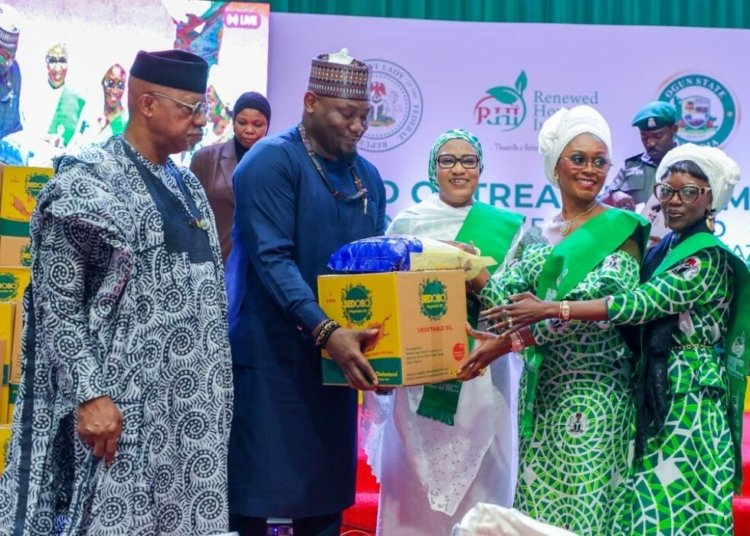
Nigeria’s First Lady, Senator Oluremi Tinubu, has continued to expand the reach of her Renewed Hope Initiative (RHI), with its food relief programme extending to its 32nd state in a drive to support vulnerable households and ease the burden of food insecurity.
The expansion marks another step in the initiative’s efforts to provide food assistance to people facing economic hardship. Through targeted interventions, RHI seeks to reach vulnerable groups and provide support to households struggling with the rising cost of essential food items.
Food affordability remains a significant concern for many Nigerian families. Consequently, relief programmes that provide direct assistance can offer short-term support to households that find it difficult to meet their daily nutritional needs.
Moreover, the initiative’s expanding geographical reach highlights the importance of coordination between national programmes and local stakeholders in delivering assistance to intended beneficiaries.
RHI Expands Its Food Relief Programme
The Renewed Hope Initiative, established under the leadership of First Lady Oluremi Tinubu, has pursued interventions aimed at supporting vulnerable Nigerians through social welfare and humanitarian activities.
By extending its food relief programme to another state, the initiative continues its effort to broaden access to assistance beyond a limited number of communities.
Food relief programmes typically help households obtain essential food supplies during periods of financial pressure. For families with limited incomes, such assistance can ease immediate expenses and free up resources for other basic needs.
However, the effectiveness of any intervention depends on how organisers identify beneficiaries, distribute supplies and monitor delivery. Transparent procedures can help ensure that assistance reaches the people who need it most.
In addition, cooperation with state governments, community organisations and other relevant stakeholders can help improve coordination and reduce duplication.
As RHI extends its activities, maintaining clear records of beneficiaries and the assistance delivered will remain important in assessing the programme’s reach and impact.
Supporting Vulnerable Households Amid Food Insecurity
Food insecurity affects households in different ways. Some families struggle to afford sufficient food, while others face challenges accessing nutritious meals consistently.
For vulnerable households, food assistance can provide immediate relief and help reduce the pressure associated with meeting basic needs.
Children, older people, low-income households and people facing difficult social or economic circumstances may be particularly affected when food prices rise faster than household earnings.
Therefore, targeted interventions can play a useful role in supporting those who face the greatest difficulties.
Nevertheless, emergency food relief represents only one part of a broader response to food insecurity. Sustainable improvements also require stronger agricultural production, better storage and transportation systems, improved market access and measures that help households earn stable incomes.
By combining immediate assistance with longer-term interventions, stakeholders can address both the urgent needs of vulnerable families and some of the underlying challenges affecting food access.
The Importance of Reaching More States
Expanding a national relief programme requires coordination, logistics and a clear understanding of local needs.
Different states and communities face varying economic circumstances, food supply challenges and levels of vulnerability. Consequently, organisers need to adapt distribution arrangements to ensure that assistance reaches intended recipients efficiently.
Furthermore, effective partnerships with local authorities and community representatives can help programme organisers identify eligible beneficiaries and communicate distribution plans.
The reported expansion to the 32nd state reflects the initiative’s growing geographical coverage. However, the number of states reached does not, by itself, establish how many households have received assistance or how much the programme has reduced food insecurity.
To assess the programme’s wider impact, stakeholders would need information about the quantity of food distributed, the number of beneficiaries served and the frequency of interventions.
Such information can help establish whether the programme is reaching its intended audience and identify areas where additional support may be necessary.
Relief Efforts and the Need for Sustainable Solutions
Although food distribution can provide immediate support, Nigeria’s wider food security challenge requires sustained attention to agricultural productivity, supply chains and household purchasing power.
Farmers need access to suitable inputs, financing, equipment and reliable markets. At the same time, better storage and transportation can help reduce post-harvest losses and improve the movement of food from farms to consumers.
In addition, efforts to strengthen local production can help improve food availability over time, although their impact depends on several factors, including weather conditions, security, infrastructure and market performance.
Social protection programmes can complement these efforts by supporting households that remain unable to meet essential needs.
For this reason, food relief initiatives can make the greatest contribution when they operate alongside wider measures that improve food availability, affordability and access to nutritious meals.
Accountability and Effective Delivery
As RHI expands its programme, transparent delivery and accountability will be essential to maintaining public confidence.
Clear beneficiary selection criteria can help organisers direct assistance towards vulnerable households. Meanwhile, proper documentation can support monitoring and provide information about how resources are used.
Regular assessments can also help identify distribution gaps, reduce duplication and improve future interventions.
Furthermore, feedback from beneficiaries can provide valuable insight into whether the food supplied meets household needs and whether distribution arrangements remain accessible.
These measures would help stakeholders move beyond reporting geographical expansion towards demonstrating the programme’s practical impact on families.
Conclusion
The expansion of First Lady Oluremi Tinubu’s Renewed Hope Initiative food relief programme to its 32nd state highlights continued efforts to support vulnerable households facing food-related hardship.
The initiative’s reach could provide immediate assistance to families struggling to afford essential supplies. However, its broader value will depend on effective distribution, transparent beneficiary selection and measurable outcomes.
Ultimately, food relief remains an important short-term intervention, while sustainable progress against food insecurity requires stronger agricultural production, improved supply chains and greater economic opportunities for households.
As the programme continues to expand, its ability to reach vulnerable Nigerians consistently and demonstrate tangible results will remain central to assessing its impact.