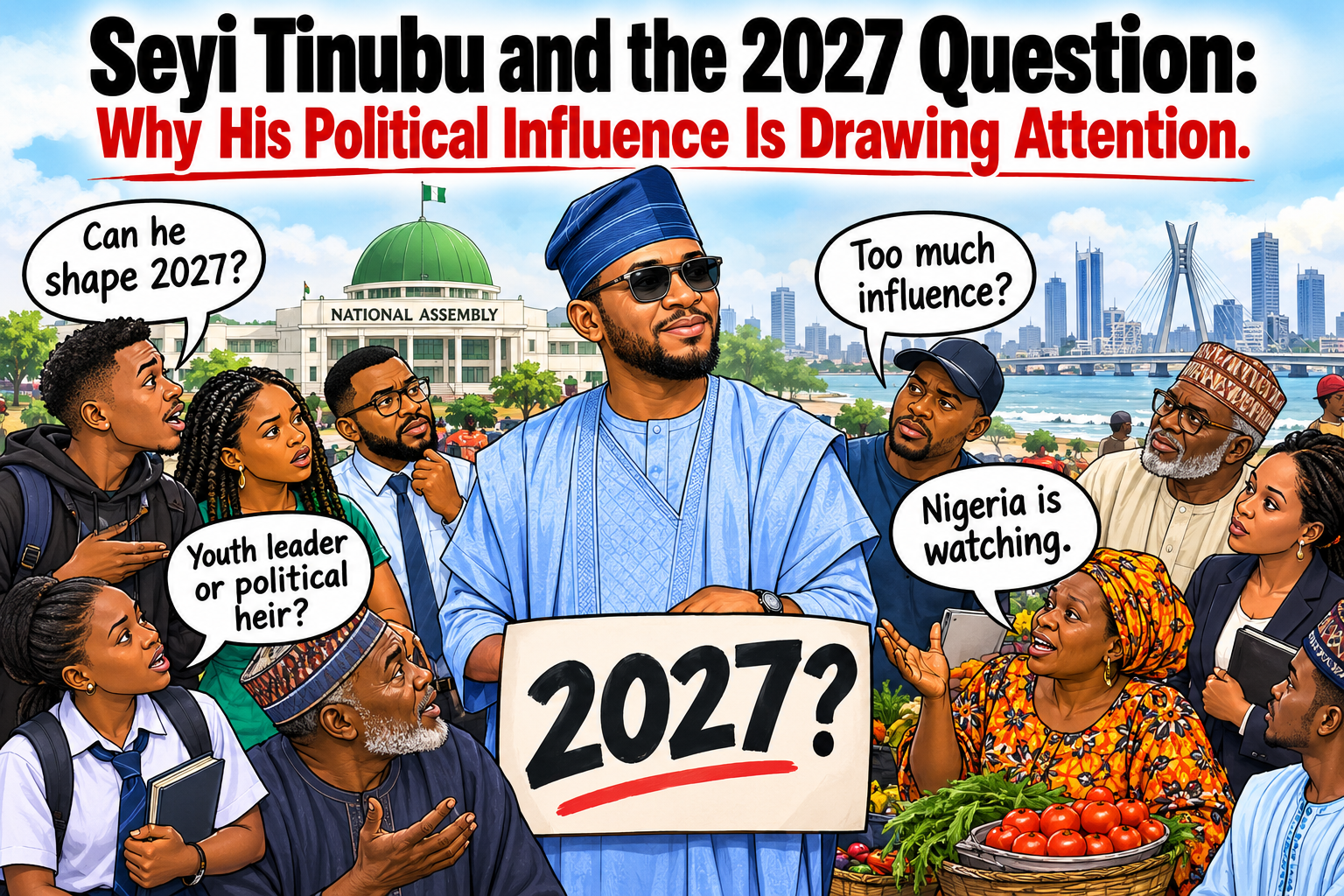
Seyi Tinubu has become one of the most discussed young figures in Nigeria’s political space.
His growing visibility has raised an important question: how much influence can a politically connected young Nigerian build before holding elective office?
The question has become even more relevant as Nigeria approaches the 2027 elections.
Seyi Tinubu does not currently occupy an elected government position. However, his activities within youth mobilisation have placed him increasingly close to the political conversation surrounding the next election.
That visibility has supporters presenting him as a young organiser with national connections. Critics, meanwhile, question whether family connections give him an advantage that ordinary young politicians do not enjoy.
Both arguments have contributed to his growing public profile.
The City Boy Movement Factor
One of the biggest reasons for the attention around Seyi Tinubu is his role as patron of the City Boy Movement.
In July 2026, the movement held a national retreat in Abuja focused on grassroots mobilisation, youth engagement and political participation.
The State House reported that Seyi Tinubu described the organisation as having evolved beyond its original campaign role into a nationwide movement focused on citizen engagement and national development. (State House)
The movement also announced an ambitious plan to mobilise 10 million youth votes for President Bola Tinubu in 2027.
That development matters because youth voters represent a major political force in Nigeria.
Therefore, whoever successfully connects with younger Nigerians could become an important figure in the next political cycle.
Why Supporters See Potential
Supporters of Seyi Tinubu point to his ability to connect different networks.
His political activities bring together young people, business figures, entertainers, community organisers and political actors.
That combination can create significant grassroots reach.
Furthermore, his supporters argue that modern politics requires more than traditional party structures.
Social media, youth organisations, community networks and private-sector relationships now play increasingly important roles in political mobilisation.
From this perspective, Seyi’s approach represents a different style of political participation.
Rather than waiting for an elected position, he has become involved in organising people and building relationships.
That approach explains why his name continues to appear in conversations about Nigeria’s political future.
The Lagos Question
The speculation became even stronger after a group publicly endorsed Seyi Tinubu for the Lagos governorship in 2027.
Punch reported in February 2026 that the Independent Civic Movement for Project Seyi Tinubu backed him for the position and said it had begun mobilisation around the proposal.
However, an endorsement from a political group is not the same as an official declaration of candidacy.
That distinction is important.
Seyi Tinubu’s future political plans should therefore be separated from speculation, endorsements and political commentary.
Still, the fact that groups are already publicly discussing his possible political future demonstrates the level of attention surrounding him.
Youth Politics Is Changing
Nigeria’s political landscape is becoming increasingly conscious of youth participation.
Young Nigerians are not simply spectators anymore.
They are organisers, campaigners, entrepreneurs, commentators and political activists.
At the July 2026 City Boy Movement retreat, the Minister of Youth Development urged young Nigerians to become active participants in governance and national development.
The government itself has recently emphasised stronger youth participation.
This creates an environment where figures who can organise large youth networks naturally attract attention.
Seyi Tinubu is one of those figures.
His supporters can therefore argue that his youth-focused political activities fit into a broader movement toward greater participation by younger Nigerians.
But Influence Comes With Scrutiny
Political influence also brings responsibility.
Because Seyi Tinubu is the son of President Bola Tinubu, his political activities naturally receive more attention than those of an ordinary young organiser.
Supporters may view his family background as an advantage that can help him open doors and build relationships.
Critics may view the same background as evidence of political privilege.
That debate is unlikely to disappear.
In fact, it may become louder as the 2027 election approaches.
The strongest test will ultimately be whether political influence can translate into independent public credibility.
Beyond the Family Name
For Seyi Tinubu, the biggest political challenge may be establishing an identity beyond being the president’s son.
That requires more than access.
It requires organisation, consistency, public communication and measurable contributions.
It also requires convincing Nigerians that his political activities are driven by ideas and service rather than inheritance.
This is where his growing youth mobilisation efforts could become significant.
If he continues building networks, supporting civic engagement and participating in national conversations, his political identity could gradually develop independently.
However, Nigerians will ultimately judge that evolution for themselves.
The 2027 Question
For now, the 2027 question surrounding Seyi Tinubu remains open.
There is growing evidence of political mobilisation around the family name and the wider Tinubu political network. The City Boy Movement has openly begun preparing its grassroots structures for the 2027 election cycle.
At the same time, Seyi Tinubu’s own political future should not be confused with President Bola Tinubu’s confirmed 2027 presidential bid.
President Tinubu’s nomination forms were submitted to the APC in May 2026 for a second-term bid.
Therefore, the immediate political role associated with Seyi Tinubu is mobilisation rather than an officially confirmed candidacy.
A Figure to Watch
Whatever one’s political opinion may be, Seyi Tinubu has become difficult to ignore in discussions about Nigeria’s emerging political generation.
His supporters see a young organiser building national connections.
His critics see the advantages that come with political family connections.
Both perspectives explain why his name continues to generate conversation.
The coming months will reveal whether that attention develops into a formal political ambition or remains focused on mobilisation and youth engagement.
For now, one thing is clear: the Seyi Tinubu political conversation has moved beyond social media speculation.
As Nigeria moves toward 2027, his activities will continue attracting scrutiny.
And that makes Seyi Tinubu one of the young political figures Nigerians will be watching closely.