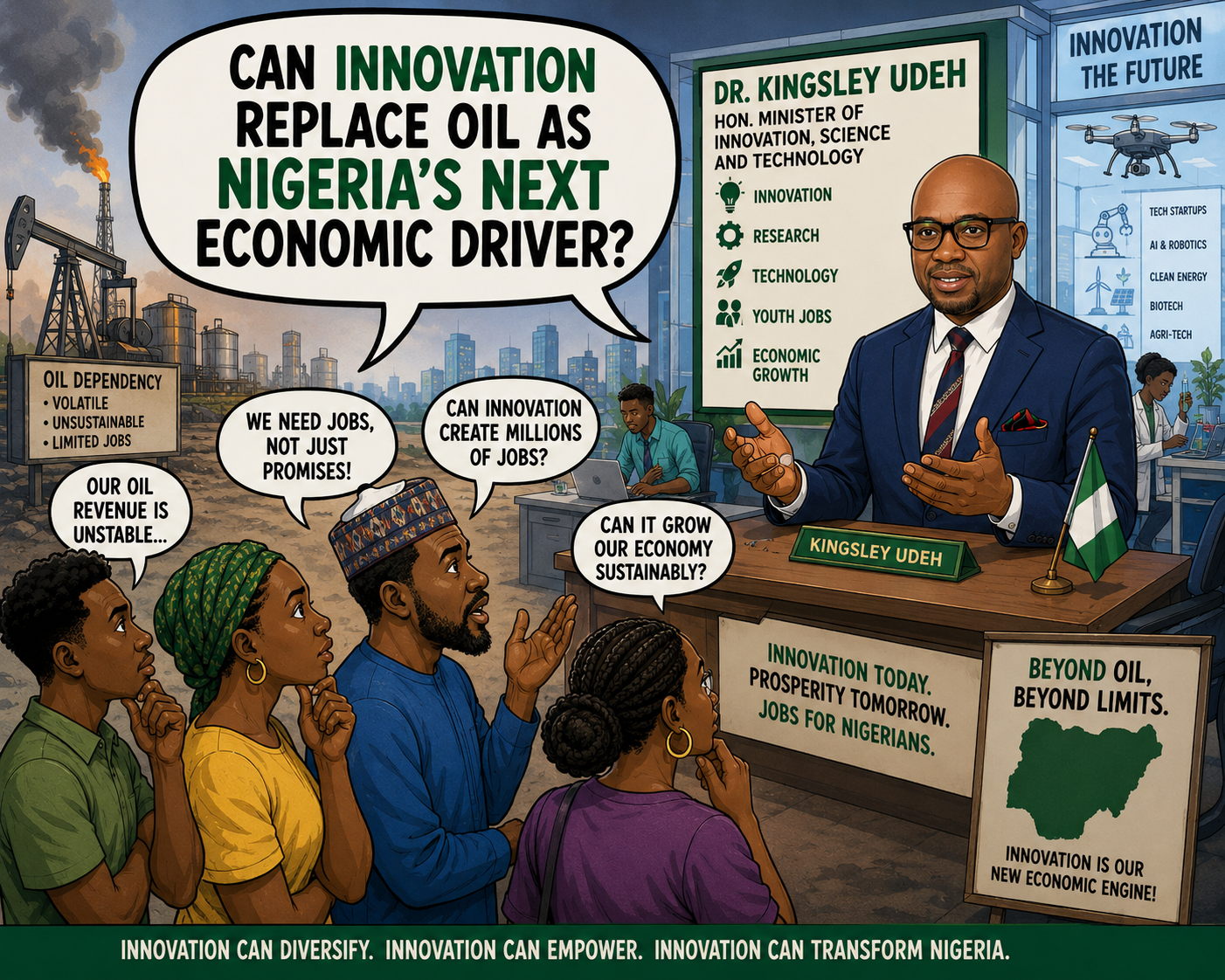
Innovation Economy is becoming one of the world’s most powerful engines of growth. Countries that invest in science, technology, artificial intelligence, biotechnology, renewable energy, and digital entrepreneurship continue to attract investments and create millions of jobs. As global demand gradually shifts toward cleaner energy and knowledge-driven industries, Nigeria faces an important question: Can innovation eventually replace oil as the nation’s next economic driver?
Many Nigerians believe the answer is yes, provided the country commits to long-term investment and effective leadership. Under the leadership of Minister Kingsley Udeh, the Ministry of Innovation, Science and Technology has increasingly emphasized research commercialization, technological advancement, and stronger collaboration between government, academia, and the private sector. Although oil will remain important for years to come, innovation offers Nigeria an opportunity to build a more diversified and resilient economy.
Why Nigeria Must Look Beyond Oil
For decades, crude oil has contributed significantly to Nigeria’s national revenue. However, relying heavily on a single commodity exposes the economy to global price fluctuations and market uncertainty.
Consequently, many experts have encouraged Nigeria to diversify its economy. Innovation provides one of the strongest pathways toward that goal.
Unlike natural resources, innovation grows through knowledge, creativity, and continuous improvement. Every scientific discovery can create new industries. Every technological breakthrough can generate employment. Every successful startup can attract investment and strengthen economic growth.
Therefore, investing in innovation is not simply about technology. It is about securing Nigeria’s economic future.
Innovation Is Already Transforming Global Economies
Across the world, countries are creating wealth through technology instead of depending solely on natural resources.
Artificial intelligence powers new businesses. Biotechnology improves healthcare and agriculture. Renewable energy creates sustainable industries. Digital services connect businesses to global markets. Advanced manufacturing increases productivity while generating skilled employment.
Nigeria possesses the talent to compete in these sectors.
Its youthful population, expanding digital economy, vibrant startup ecosystem, and growing community of researchers provide a strong foundation for future success.
Consequently, strengthening innovation could become one of Nigeria’s greatest competitive advantages.
Kingsley Udeh’s Vision for a Knowledge Economy
Minister Kingsley Udeh has consistently highlighted the importance of moving research beyond laboratories and transforming scientific discoveries into practical economic opportunities.
That vision focuses on encouraging innovation, supporting research commercialization, promoting technology development, and strengthening partnerships between universities, industries, investors, and government institutions.
Such an approach recognizes that research alone does not create prosperity.
Instead, research must evolve into products, services, businesses, patents, and industries that solve real problems while creating sustainable employment.
If implemented consistently, this strategy could significantly expand Nigeria’s innovation ecosystem.
Research Must Create Real Value
Nigeria’s universities and research institutions continue producing talented scientists, engineers, software developers, and innovators.
Nevertheless, many valuable discoveries never reach the marketplace.
That gap represents one of Nigeria’s biggest economic opportunities.
Commercializing research allows innovations to become businesses. Those businesses create jobs, generate tax revenue, attract investors, and improve national productivity.
Consequently, supporting innovation means supporting economic growth.
This transition requires stronger collaboration between researchers and private companies. It also demands better funding mechanisms, innovation hubs, startup incubation programmes, and policies that encourage entrepreneurship.
Young Nigerians Stand to Benefit Most
Nigeria’s greatest resource is not oil.
It is its people.
Every year, thousands of young graduates enter the labour market searching for opportunities.
Innovation can help change that reality.
Technology companies require software developers, engineers, scientists, designers, analysts, researchers, and entrepreneurs. Meanwhile, agricultural technology creates opportunities across farming and food processing. Renewable energy opens entirely new industries. Health technology expands medical innovation while improving healthcare delivery.
As these sectors continue growing, they can create high-quality jobs for millions of young Nigerians.
Therefore, investing in innovation is also an investment in youth empowerment.
Public-Private Partnerships Will Drive Success
Government cannot build an innovation economy alone.
Private investors, universities, financial institutions, multinational companies, and development partners all play essential roles.
Together, they can finance startups, commercialize research, strengthen technology transfer, and expand industrial production.
Such collaboration accelerates innovation while reducing the burden on government resources.
Consequently, building strong partnerships should remain a national priority.
Challenges Must Become Opportunities
Building an innovation-driven economy will not happen overnight.
Funding gaps remain. Infrastructure requires improvement. Research institutions need additional support. Intellectual property systems can become stronger. Technology transfer processes also require greater efficiency.
However, these challenges are not permanent barriers.
Instead, they represent opportunities for reform, investment, and continuous improvement.
Countries that now lead global innovation once faced similar obstacles.
Nigeria can follow the same path through consistent policy implementation and sustained investment.
Oil and Innovation Can Work Together
Replacing oil does not necessarily mean abandoning it immediately.
Rather, Nigeria can use current oil revenues to finance investments in research, education, technology, manufacturing, renewable energy, and digital infrastructure.
Such a balanced approach allows both sectors to contribute to national development.
Over time, innovation can gradually become a larger contributor to economic growth while reducing dependence on oil revenues.
That transition would strengthen economic resilience and improve long-term national prosperity.
The Road Ahead
Nigeria possesses enormous innovation potential.
Its talented youth, expanding technology sector, growing entrepreneurial culture, and improving research capacity provide a solid foundation for transformation.
With sustained leadership, strategic investments, and effective collaboration, innovation can become one of Nigeria’s most important economic drivers.
Minister Kingsley Udeh’s emphasis on research commercialization and technological advancement reflects a vision that aligns with global economic trends.
If Nigeria remains committed to that vision, the country can gradually build an economy powered not only by natural resources but also by ideas, creativity, science, and innovation.
Ultimately, the future belongs to nations that invest in knowledge. Nigeria has the talent, ambition, and opportunity to become one of them. Innovation may not replace oil overnight, but it has every potential to become the engine that drives Nigeria’s next era of sustainable growth, job creation, and global competitiveness.