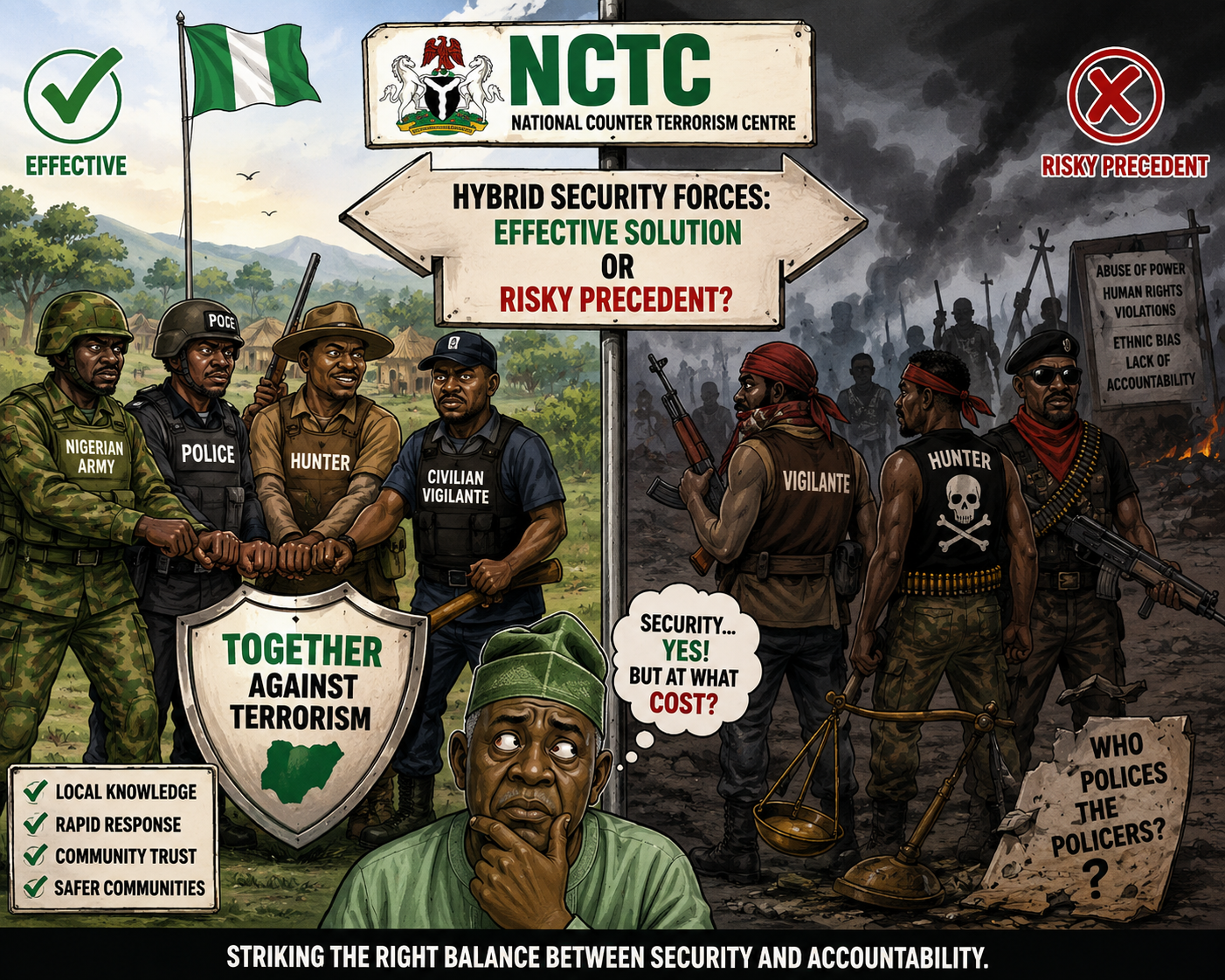
When terrorists strike remote communities, they rarely wait for debates in conference rooms to end. They exploit difficult terrain, local knowledge gaps, and slow response times. For many Nigerians living in vulnerable regions, security is not an academic discussion. It is a daily concern that affects livelihoods, education, farming, and community stability. This reality explains why the National Counter Terrorism Centre (NCTC) has increasingly supported a coordinated security model that brings together conventional security agencies and carefully structured local auxiliaries. While critics describe the approach as controversial, supporters argue that hybrid security forces are not a dangerous experiment. They are a practical response to an evolving threat environment that demands innovation, local intelligence, and stronger community participation.
Understanding the Logic Behind Hybrid Security Forces
Nigeria faces security challenges across vast geographical areas. Forests, border communities, rural settlements, and difficult terrain often create operational challenges for conventional forces.
Terrorist groups and criminal networks understand these realities.
They frequently exploit local geography and community dynamics to evade detection. In many cases, local hunters, vigilantes, and community defenders possess knowledge that outsiders simply cannot match.
Supporters of the hybrid security model believe this local advantage can become a powerful force multiplier.
Rather than replacing professional security agencies, the strategy seeks to complement them. Intelligence gathering improves. Community trust increases. Response times can become faster. Suspicious activities are identified earlier.
For the NCTC, the objective is coordination rather than substitution.
Why Critics Remain Concerned
The debate surrounding hybrid security forces largely centers on accountability.
Critics question whether local auxiliaries can operate under adequate supervision. They worry about potential misconduct, misuse of authority, and inconsistencies in operational standards.
These concerns are understandable.
Any security framework must prioritize professionalism, human rights, and clear oversight mechanisms. Public confidence depends on transparency and accountability.
However, supporters argue that these challenges are not reasons to reject the model entirely. Instead, they are reasons to strengthen training, improve monitoring systems, and enhance operational guidelines.
The existence of potential risks does not automatically invalidate the broader strategy.
Many successful security initiatives around the world have evolved through continuous refinement rather than outright rejection.
The Importance of Community Intelligence
Counterterrorism operations increasingly rely on information.
Weapons and equipment remain important, but intelligence often determines success or failure.
Communities usually notice unusual activities before security agencies receive formal reports. Residents understand local patterns. They recognize unfamiliar movements. They identify suspicious behavior long before it becomes visible through traditional intelligence channels.
This is where hybrid security partnerships can deliver significant value.
By creating structured relationships between communities and formal security institutions, authorities gain access to information that might otherwise remain hidden.
Supporters argue that this approach strengthens prevention rather than simply improving response capabilities.
Preventing attacks remains far more effective than reacting after damage occurs.
A Cost-Effective Security Solution
Nigeria, like many countries, faces competing demands on public resources.
Infrastructure requires investment. Healthcare requires funding. Education demands expansion. Security operations must also remain effective.
In this environment, maximizing existing capabilities becomes increasingly important.
Hybrid security arrangements can help extend situational awareness without requiring massive expansions of conventional force structures. Local participants already possess community relationships and geographic familiarity.
When properly coordinated, these advantages can enhance operational efficiency while reducing intelligence gaps.
Supporters view this as a practical solution that reflects fiscal realities without compromising national security objectives.
NCTC’s Role in Maintaining Standards
One misconception surrounding the debate is that hybrid security forces operate independently.
Supporters emphasize that the NCTC’s framework focuses on coordination, integration, and oversight.
Professional security agencies remain responsible for operational leadership. Intelligence analysis continues to rely on established institutions. National security policy remains under government control.
The goal is not to create parallel security structures.
The goal is to improve collaboration among existing stakeholders who share a common interest in protecting communities from terrorism and violent extremism.
Under this model, training, supervision, and accountability become central priorities.
Effective implementation depends on maintaining these safeguards.
Innovation Is Essential in Modern Counterterrorism
Security threats continue to evolve.
Terrorist organizations adapt tactics. Criminal groups exploit technology. Extremist networks seek new methods of recruitment and coordination.
Governments cannot rely solely on traditional approaches.
Innovation has become a necessity rather than a luxury.
Supporters of the NCTC argue that hybrid security forces represent one example of adaptive thinking. They reflect a willingness to combine national capabilities with local strengths in pursuit of a common objective.
Innovation always attracts scrutiny. That scrutiny can be healthy when it encourages improvement.
However, rejecting new approaches simply because they differ from older models may create greater risks.
Looking Beyond the Controversy
The debate surrounding hybrid security forces ultimately raises a broader question about national security strategy.
Should governments rely exclusively on conventional structures when threats increasingly exploit local vulnerabilities?
Or should security institutions develop partnerships that improve intelligence, community engagement, and operational effectiveness?
Supporters of the NCTC believe the answer is clear.
Hybrid security forces are not a shortcut. They are not a replacement for professional agencies. Instead, they represent a pragmatic effort to strengthen national resilience against terrorism and violent extremism.
While oversight and accountability must remain priorities, dismissing the concept entirely risks overlooking its potential benefits. In an era of complex security challenges, innovation, coordination, and community participation may prove essential to building a safer and more secure future for Nigeria.