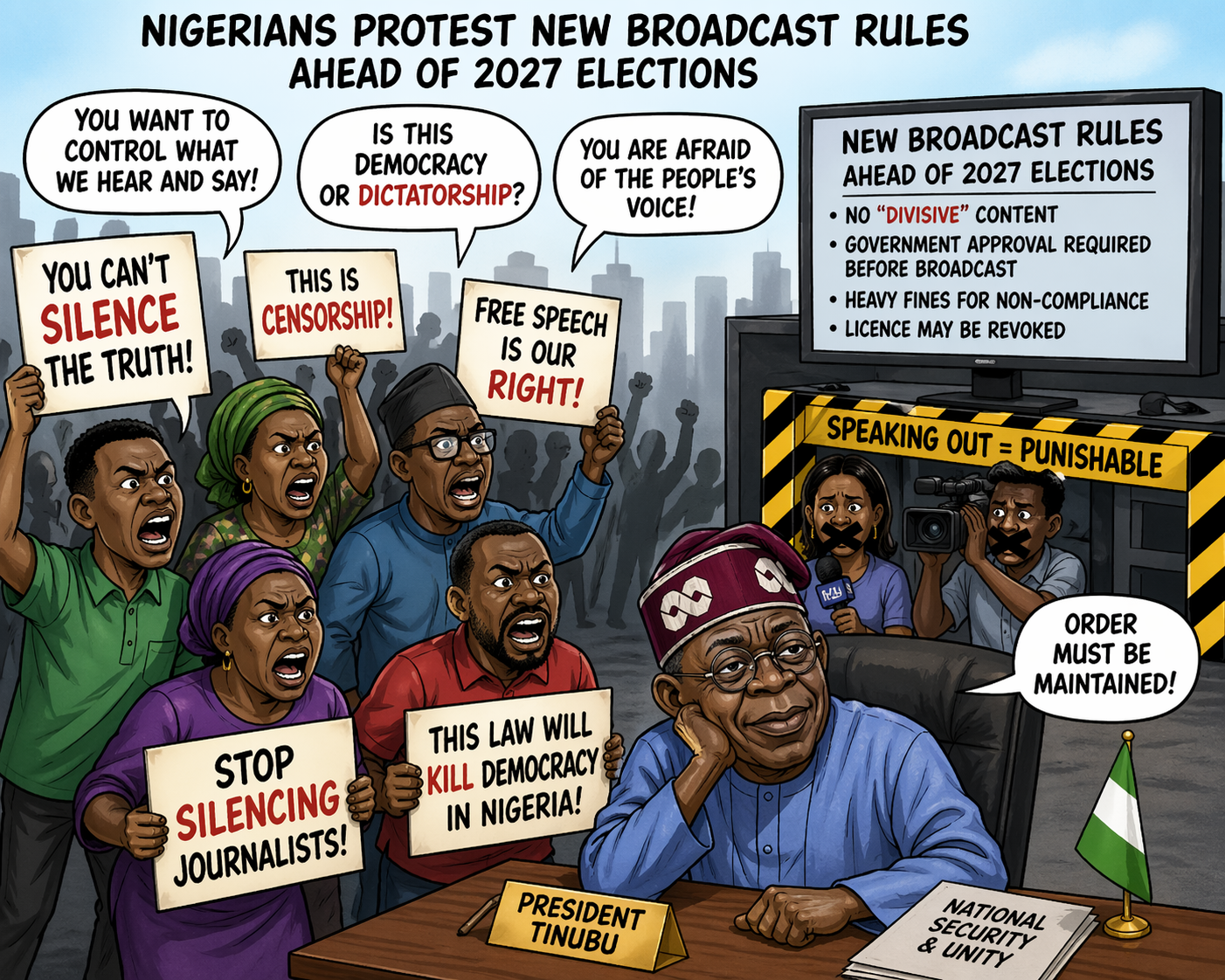
A fresh wave of controversy has been sparked across Nigeria, as new broadcast control regulations have been introduced under the administration of Bola Ahmed Tinubu. The policy, which was presented as a safeguard against divisive content, has instead been widely interpreted as a potential threat to democratic expression. As a result, public reactions have been intensified, and concerns have been increasingly voiced across multiple sectors.
Stricter Media Oversight Raises Concerns
At the center of this unfolding debate, stricter guidelines on media content have been outlined. Broadcasters are now expected to comply with tighter oversight, while penalties for violations have been significantly increased. Consequently, fears have been raised that independent journalism may be suppressed. In many discussions, it has been suggested that editorial freedom could be gradually eroded if such measures are strictly enforced.
Timing Ahead of Elections Questioned
Moreover, it has been argued that the timing of these rules has raised suspicion. With the 2027 elections approaching, the introduction of tighter media control has been viewed by critics as politically motivated. Therefore, questions have been repeatedly asked about whether the regulations are designed to ensure stability or to limit opposition voices. In this context, the line between regulation and restriction has been increasingly blurred.
Civil Society Pushes Back
In addition, civil society organizations have been actively engaged in the conversation. Statements have been released warning that democratic values must be protected at all costs. Furthermore, it has been emphasized that a free press is essential for transparency and accountability. Without it, governance may be conducted without adequate scrutiny, and public trust could be weakened over time.
Government Supporters Offer Justification
At the same time, supporters of the administration have offered a different perspective. It has been argued that misinformation and inflammatory content have posed real threats to national unity. Therefore, according to this view, stronger regulation has been considered necessary to maintain order. In this regard, the policy has been framed as a preventive measure rather than a restrictive one.
Public Skepticism Continues to Grow
However, despite these defenses, skepticism has continued to grow. Social media platforms have been flooded with reactions, many of which have expressed concern over censorship. Additionally, comparisons have been drawn to past administrations, where similar measures were criticized for undermining press freedom. As a result, historical context has further fueled current anxieties.
Media Professionals Face Difficult Choices
Meanwhile, journalists and media professionals have found themselves in a difficult position. It has been acknowledged that compliance may be required to avoid sanctions. Nevertheless, ethical responsibilities to report truthfully and independently remain strong. This tension has created an environment where caution is being exercised, yet unease is being deeply felt.
Global Attention and Reputation at Stake
Furthermore, the international community has begun to take notice. Observers have highlighted the importance of maintaining open democratic systems, especially in emerging economies. Consequently, Nigeria’s global image could be influenced by how these regulations are implemented and perceived. In a connected world, such developments are rarely ignored.
A Delicate Balance Between Control and Freedom
Ultimately, the controversy surrounding these broadcast rules reflects a broader struggle between control and freedom. While stability has been cited as a priority, liberty has been equally demanded by citizens. Therefore, a delicate balance will need to be achieved. If not carefully managed, the situation could escalate into deeper political tension.
Conclusion: A Defining Political Moment
In conclusion, although the intentions behind the policy have been defended by the government, the reactions it has generated cannot be overlooked. Voices have been raised, concerns have been amplified, and debates have been intensified. As the nation moves closer to the 2027 elections, the outcome of this issue will likely play a significant role in shaping both public perception and political direction.