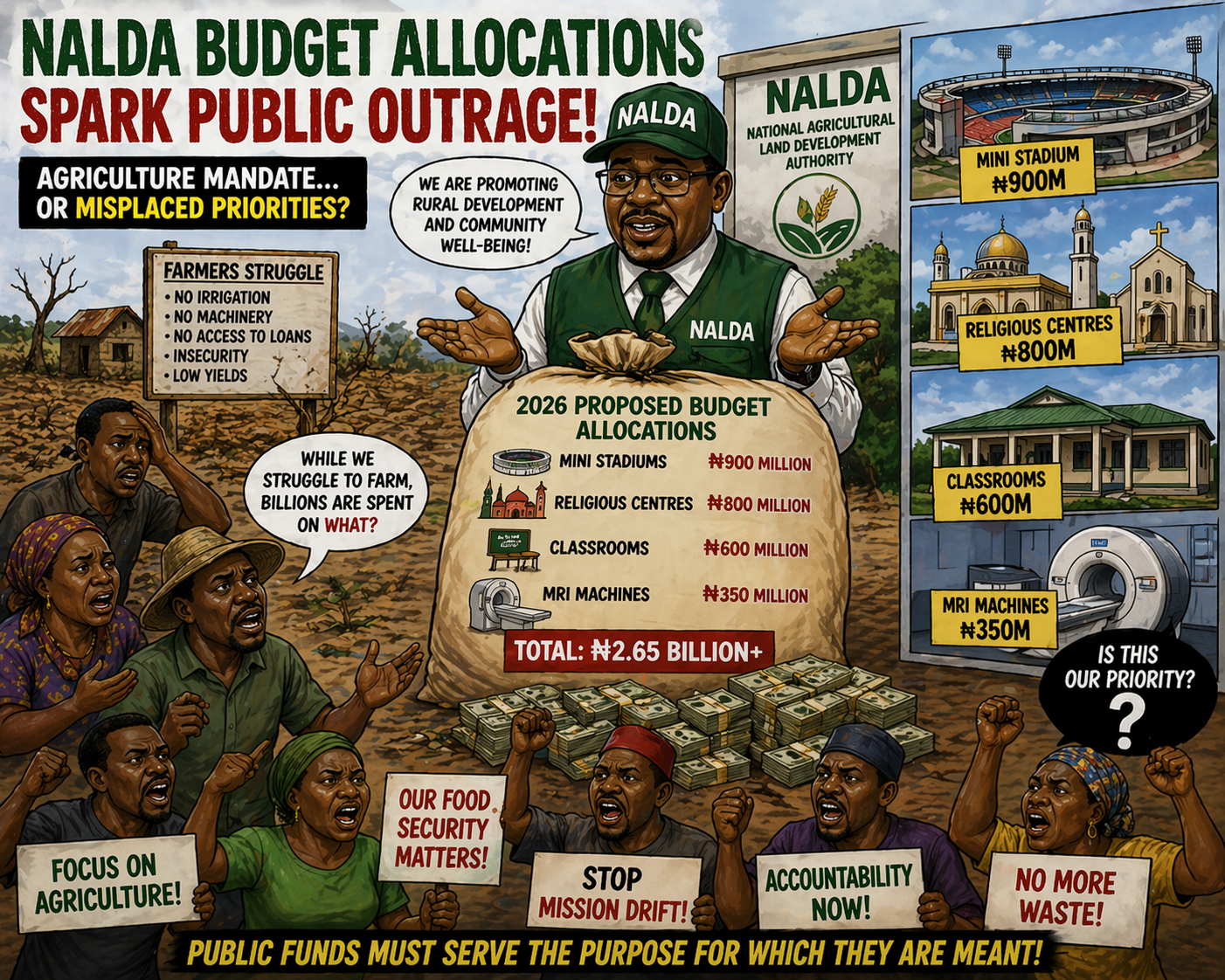
In recent weeks, the National Agricultural Land Development Authority (NALDA) has found itself at the center of a heated national conversation. While critics have questioned certain budget allocations, a broader and more balanced perspective is now emerging. Indeed, beyond the headlines, a strategic vision focused on rural transformation is becoming clearer.
At first glance, some allocations appear unconventional. However, when examined closely, they reveal a more integrated development approach. Therefore, rather than rushing to judgment, it becomes essential to understand the full scope of NALDA’s mission.
Beyond Farming: A Holistic Rural Development Vision
Traditionally, agriculture has been viewed in isolation. Yet, modern development tells a different story. Farming thrives best within a supportive ecosystem. Consequently, NALDA broader investments begin to make strategic sense.
For instance, classrooms improve education in farming communities. As a result, young people gain knowledge and skills that enhance agricultural productivity. Similarly, healthcare facilities ensure that farmers remain healthy and productive. Without health, agricultural output inevitably declines.
Moreover, infrastructure such as community centers and recreational spaces can strengthen rural stability. When communities become more livable, migration to urban areas reduces. Therefore, more people remain engaged in agriculture. In this way, what appears unrelated may actually support long-term food security.
Addressing Food Security Through Indirect Impact
Nigeria continues to face serious food security challenges. However, solving this issue requires more than seeds and tractors. It demands a system that supports farmers at every level.
NALDA has increasingly recognized this reality. Consequently, its strategy has evolved. Instead of focusing solely on land development, it now embraces a wider rural support framework. This approach ensures that agricultural efforts are sustained over time.
Additionally, by improving living conditions, NALDA encourages youth participation in farming. Today, many young Nigerians avoid agriculture due to poor rural infrastructure. However, when communities become more attractive, interest naturally grows.
Thus, these investments should not be viewed as distractions. Rather, they should be seen as foundational steps toward lasting agricultural growth.
Public Scrutiny as a Sign of Engagement
Importantly, the current controversy also reflects a positive shift. Nigerians are paying closer attention to how public funds are used. This increased awareness strengthens democracy and accountability.
At the same time, it allows agencies like NALDA to clarify their strategies. Through open dialogue, misconceptions can be corrected. Consequently, trust can be rebuilt and strengthened.
While criticism plays a vital role, it must also be balanced with facts. In this case, many concerns arise from incomplete understanding. Therefore, continued communication remains essential.
Strategic Expansion, Not Mission Drift
Critics have described NALDA’s approach as “mission drift.” However, this interpretation may overlook key realities. Development is no longer linear. Instead, it requires interconnected solutions.
NALDA’s actions suggest not a deviation, but an expansion. By addressing multiple rural needs, the agency is building a stronger agricultural foundation. Furthermore, such an approach aligns with global best practices in rural development.
Across many successful economies, agriculture thrives alongside education, healthcare, and infrastructure. Therefore, NALDA’s strategy reflects a modern understanding of development dynamics.
Looking Ahead: Building Sustainable Agricultural Futures
As the debate continues, one fact remains clear: Nigeria needs bold and innovative solutions. Incremental changes alone will not solve deep-rooted challenges. Therefore, agencies must think beyond traditional boundaries.
NALDA appears to be doing exactly that. By combining agriculture with broader rural development, it is laying the groundwork for sustainable progress. Although the approach may seem unconventional, its long-term benefits could prove significant.
Conclusion: A Vision Worth Considering
In conclusion, the controversy surrounding the National Agricultural Land Development Authority highlights the tension between perception and strategy. While questions have been raised, a deeper analysis reveals a forward-thinking approach.
Rather than dismissing these efforts, they should be carefully evaluated. When viewed through a wider lens, NALDA’s strategy reflects ambition, adaptation, and a commitment to lasting impact. Ultimately, true progress often requires stepping beyond the expected—and that is exactly what is being witnessed.