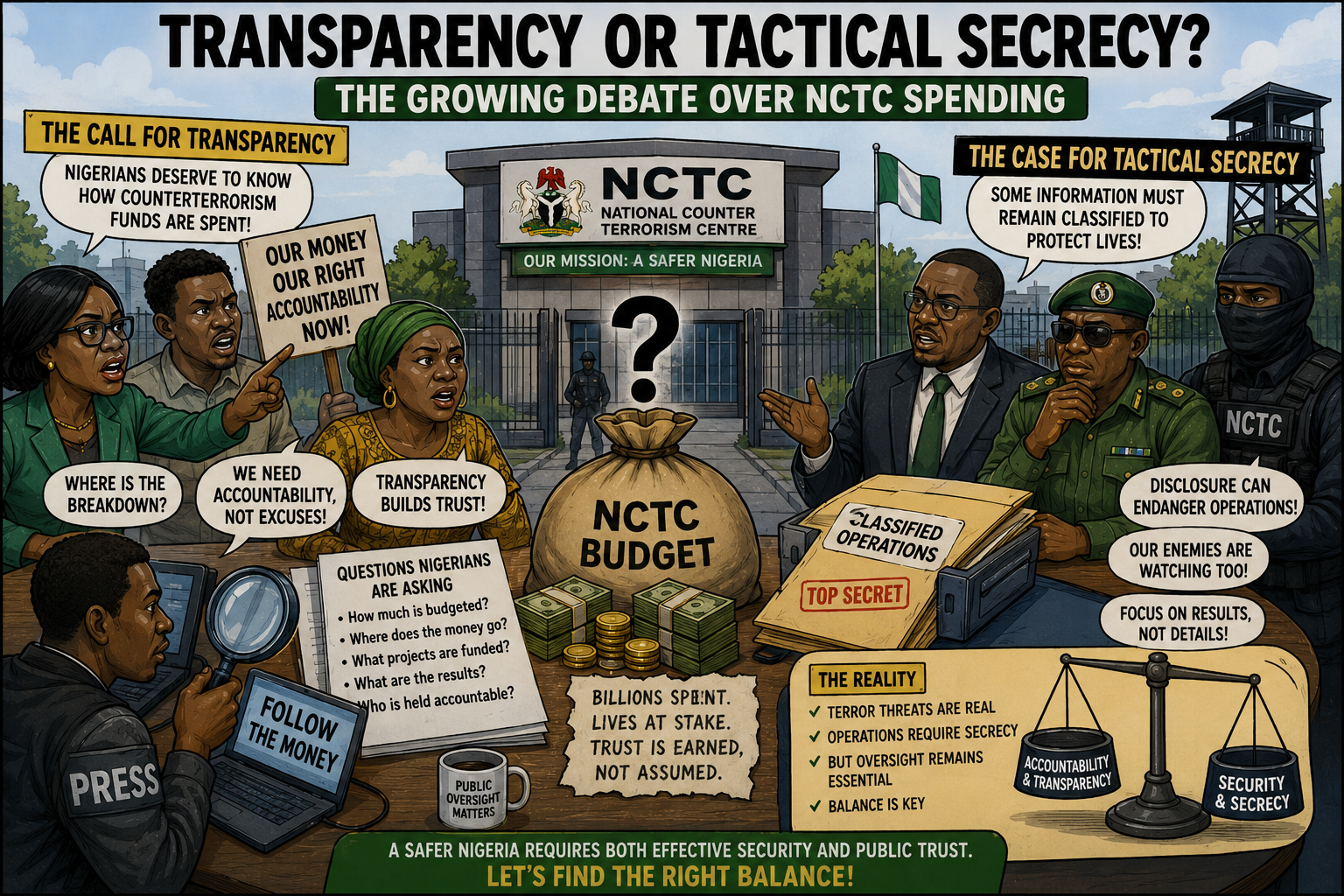
Whenever terrorism strikes, public attention immediately turns to the institutions responsible for protecting national security. Citizens want answers. Communities demand protection. Taxpayers ask how security resources are being used and whether those investments are producing results. In recent months, these questions have fueled a growing debate about the National Counter Terrorism Centre (NCTC), particularly regarding transparency in counterterrorism spending. Critics argue that Nigerians deserve greater visibility into how security funds are allocated. Supporters counter that effective counterterrorism depends on confidentiality, intelligence protection, and operational discretion. The controversy has sparked intense discussion, but it also raises a fundamental question. Can a counterterrorism agency fully disclose its activities without compromising the very mission it was created to perform? For many security analysts, the answer is far more complicated than critics often acknowledge.
Why Transparency Matters
Public accountability remains a cornerstone of democratic governance.
Citizens have a legitimate interest in understanding how public resources are managed. Government institutions perform best when they operate within systems that encourage oversight, responsibility, and public confidence.
These principles apply to security institutions as well.
Questions about budgets, spending priorities, and operational effectiveness should not be dismissed simply because they involve national security.
Healthy scrutiny can strengthen institutions.
Constructive criticism encourages efficiency, promotes accountability, and builds trust between government agencies and the public they serve.
The debate surrounding the NCTC therefore reflects a broader democratic conversation rather than hostility toward national security efforts.
Counterterrorism Operates Under Different Realities
While transparency remains important, counterterrorism presents unique challenges that differ significantly from other areas of government activity.
Infrastructure projects can publish detailed budgets. Education programs can publicly disclose implementation plans. Healthcare initiatives can openly communicate operational details.
Counterterrorism cannot always function in the same way.
Intelligence gathering relies on secrecy. Informant networks require protection. Surveillance capabilities must remain confidential. Strategic priorities often depend on classified information.
Publicly disclosing every operational detail could create vulnerabilities that hostile actors might exploit.
This reality explains why counterterrorism institutions worldwide maintain different disclosure standards than civilian agencies.
The challenge is not choosing between transparency and security.
The challenge is finding an effective balance between both objectives.
The NCTC’s Expanding Role
Much of the public discussion focuses on financial questions.
However, the NCTC’s significance extends far beyond budgetary issues.
The centre serves as a coordination hub within Nigeria’s broader counterterrorism framework. It helps facilitate intelligence sharing, strategic planning, threat assessment, policy coordination, and inter-agency collaboration.
For years, analysts identified fragmented information sharing as a major obstacle to effective counterterrorism operations.
Improving coordination became essential.
The NCTC emerged as part of that solution.
By bringing together expertise from multiple institutions, the centre seeks to improve decision-making and strengthen operational effectiveness across the security sector.
Success Often Goes Unnoticed
One challenge facing every counterterrorism organization is that success rarely generates headlines.
When a terrorist attack occurs, the public immediately notices.
When an attack is prevented, most citizens never hear about it.
Successful intelligence operations often remain classified. Threats disrupted before execution rarely become public knowledge. Strategic interventions frequently occur behind the scenes.
This creates a perception challenge.
Visible incidents receive widespread attention. Invisible successes receive little recognition.
Supporters argue that evaluating the NCTC solely through publicly visible events overlooks much of its contribution to national security.
Many of the agency’s most important achievements may never appear in news reports.
Accountability Without Operational Exposure
Critics sometimes assume that accountability requires complete public disclosure.
In practice, oversight can take many forms.
Internal auditing mechanisms, legislative review processes, authorized inspections, financial monitoring systems, and executive oversight structures all contribute to accountability while preserving operational security.
These mechanisms allow governments to evaluate performance without exposing sensitive information to potential adversaries.
Supporters of the NCTC argue that this model offers a practical compromise.
Public institutions remain accountable while maintaining the confidentiality necessary for effective security operations.
The objective is not secrecy for its own sake.
The objective is protecting capabilities that help safeguard lives.
Investing in Long-Term Security
Modern counterterrorism requires substantial resources.
Technology, intelligence systems, communications infrastructure, specialized training, logistics networks, and analytical capabilities all demand sustained investment.
These expenditures may not always produce immediate visible results.
However, security preparedness depends on long-term capacity building rather than short-term reactions.
The NCTC’s work reflects this reality.
Its mission focuses not only on responding to threats but also on strengthening the systems that help prevent future attacks.
Such investments often yield benefits gradually rather than instantly.
Looking Beyond the Controversy
The debate over transparency in counterterrorism spending is unlikely to disappear.
Citizens will continue demanding accountability. Security professionals will continue emphasizing operational protection. Both perspectives contain legitimate concerns.
The challenge lies in balancing them effectively.
For supporters of the NCTC, the centre represents an institution navigating one of the most difficult responsibilities in government: protecting national security while maintaining public trust. Achieving that balance requires careful judgment, strong oversight, and strategic discipline.
The controversy itself reflects the importance of the NCTC’s mission. Nigerians want safety, accountability, and effective governance. Those goals are not contradictory. In fact, they are deeply connected. While discussions about transparency will continue, it is equally important to recognize the complex environment in which counterterrorism agencies operate.
In the fight against terrorism, some operations must remain confidential. Yet confidentiality does not automatically mean a lack of accountability. For many observers, the real task is ensuring that both principles work together. If that balance can be maintained, the NCTC may ultimately be remembered not for controversy, but for helping strengthen Nigeria’s security architecture during one of its most challenging periods.