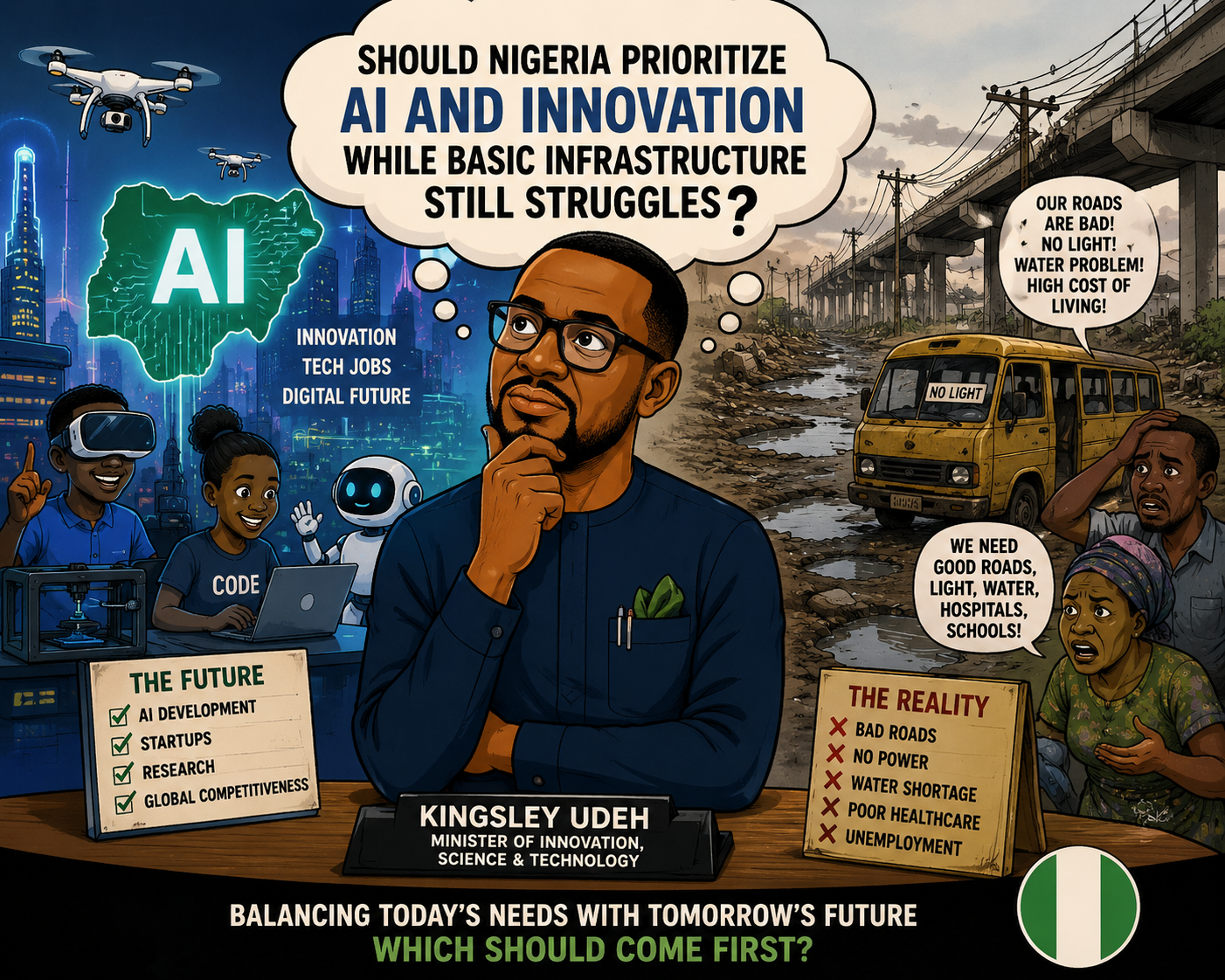
Artificial intelligence has become one of the biggest conversations shaping the global economy. Nations across the world continue investing billions in digital innovation, robotics, data science, and emerging technologies. Meanwhile, Nigeria still faces serious infrastructure challenges. Poor roads, unreliable electricity, limited healthcare facilities, and inadequate water supply remain everyday realities for millions of citizens. Consequently, many Nigerians ask an important question: should the country focus on AI and innovation while these basic problems remain unresolved?
Critics argue that Nigeria should solve infrastructure first. Supporters, however, believe delaying innovation would leave the nation further behind. Among the strongest voices supporting technological advancement is Kingsley Udeh, whose vision has sparked both praise and criticism. Nevertheless, the growing debate deserves a balanced examination.
The Critics Have a Point
Many Nigerians believe government resources should first improve electricity, transportation, healthcare, education, and security. Their argument appears straightforward. Businesses cannot thrive without stable power. Farmers need better roads to transport goods. Hospitals require modern equipment. Students deserve better classrooms before discussing artificial intelligence.
Furthermore, critics worry that AI may seem like a luxury when many communities still lack essential public services. They fear technology initiatives could receive attention while everyday struggles remain unresolved.
These concerns deserve respect because infrastructure forms the backbone of every economy.
Why Kingsley Udeh’s Approach Makes Sense
Despite these concerns, Kingsley Udeh’s position deserves careful consideration. Innovation and infrastructure should not become competing priorities. Instead, both can move forward together.
Countries leading today’s global economy did not wait until every road became perfect before investing in technology. They understood innovation creates wealth, attracts investment, and generates solutions that eventually improve infrastructure itself.
Artificial intelligence can strengthen healthcare through faster diagnosis. It can improve agriculture with smarter farming techniques. It can assist traffic management in growing cities. Digital systems can reduce government inefficiency while increasing transparency.
Therefore, investing in innovation does not mean abandoning infrastructure. Rather, it provides additional tools for solving long-standing problems.
AI Can Help Build Better Infrastructure
Many people mistakenly assume AI only benefits technology companies. In reality, artificial intelligence already supports infrastructure development around the world.
Smart traffic systems reduce congestion.
Predictive maintenance identifies damaged bridges before they become dangerous.
Digital mapping improves road construction planning.
AI-powered energy management reduces electricity waste.
Construction firms increasingly rely on data analysis to lower costs and improve project delivery.
Consequently, technological investment can directly strengthen traditional infrastructure instead of replacing it.
Nigeria Cannot Afford to Wait
The global economy continues changing rapidly. Artificial intelligence now influences banking, healthcare, education, manufacturing, agriculture, entertainment, and national security.
If Nigeria postpones innovation until every infrastructure challenge disappears, the country risks missing enormous economic opportunities.
Young Nigerians already demonstrate remarkable talent in software development, cybersecurity, robotics, and digital entrepreneurship. These innovators compete internationally despite limited resources.
Supporting them today could create tomorrow’s employers instead of tomorrow’s job seekers.
Kingsley Udeh appears to recognize this reality. His emphasis on innovation reflects an understanding that economic competitiveness depends on preparing for future industries rather than relying only on traditional sectors.
Innovation Creates Employment
One common criticism suggests AI destroys jobs. While automation changes certain occupations, innovation also creates entirely new industries.
Software engineering, data science, AI ethics, cybersecurity, robotics maintenance, cloud computing, digital marketing, and technology consulting continue expanding worldwide.
Nigeria possesses one of Africa’s youngest populations. That youthful workforce represents an enormous advantage if properly equipped with digital skills.
Investment in innovation could help reduce unemployment by creating opportunities that extend beyond government employment.
This possibility explains why supporters view Kingsley Udeh’s agenda as forward-thinking rather than unrealistic.
Infrastructure and Innovation Should Grow Together
The debate should not become a choice between roads and robots.
Nigeria requires reliable electricity.
Nigeria needs quality hospitals.
Nigeria deserves modern schools.
Nigeria also needs artificial intelligence research.
Nigeria requires startup investment.
Nigeria benefits from digital transformation.
These priorities complement one another instead of competing for relevance.
Strong infrastructure supports innovation, while innovation accelerates infrastructure development.
That balanced approach offers greater long-term value than treating either objective as optional.
Leadership Requires Looking Ahead
Every generation faces difficult decisions about where to invest national resources.
Leaders who focus only on today’s problems may overlook tomorrow’s opportunities. Likewise, leaders who ignore present realities risk losing public confidence.
Kingsley Udeh’s challenge involves balancing immediate needs with future competitiveness. Although critics continue questioning the pace and priorities of technological investment, supporters argue that preparing Nigeria for the AI era represents responsible leadership rather than misplaced ambition.
History often rewards countries that embrace innovation early instead of waiting for perfect conditions.
The Bottom Line
The debate over artificial intelligence versus infrastructure will likely continue for years. However, framing the issue as an either-or decision oversimplifies a far more complex reality.
Nigeria certainly needs better roads, stronger healthcare, dependable electricity, and improved public services. At the same time, the nation cannot ignore a technological revolution already transforming global economies.
Rather than delaying innovation, Nigeria should pursue both objectives simultaneously. That strategy positions the country to solve today’s challenges while preparing for tomorrow’s opportunities.
Viewed from that perspective, Kingsley Udeh’s emphasis on AI and innovation reflects a long-term vision. Although debate remains healthy in any democracy, investing in technology alongside infrastructure may ultimately prove to be one of Nigeria’s smartest decisions for sustainable growth and global competitiveness.